


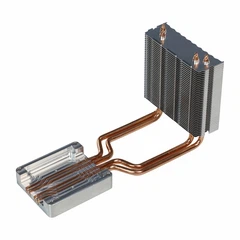
As a supplier of Aluminum Finned Heat Sinks, I've witnessed firsthand the critical role these components play in various industries, from electronics to automotive. One of the most frequently asked questions we encounter is about the impact of fin pitch - the distance between fins - on the efficiency of an aluminum finned heat sink. In this blog, I'll delve into this topic, exploring how fin pitch affects heat sink performance and what it means for your applications.
Understanding Heat Transfer in Aluminum Finned Heat Sinks
Before we discuss the impact of fin pitch, it's important to understand how heat transfer occurs in an aluminum finned heat sink. Heat sinks work by increasing the surface area available for heat dissipation. The fins on the heat sink provide additional surface area, allowing more heat to be transferred from the source (such as a CPU or a power transistor) to the surrounding air.
There are three main modes of heat transfer involved: conduction, convection, and radiation. Conduction is the transfer of heat through a solid material, such as the base of the heat sink. The heat is then transferred from the base to the fins through conduction. Convection is the transfer of heat between the fins and the surrounding fluid (usually air). As the air flows over the fins, it absorbs the heat and carries it away. Radiation is the transfer of heat through electromagnetic waves, which is generally less significant in most heat sink applications compared to conduction and convection.
The Role of Fin Pitch in Heat Transfer
Fin pitch plays a crucial role in both conduction and convection heat transfer. A smaller fin pitch means more fins can be packed into a given area, increasing the surface area available for heat transfer. This can potentially lead to higher heat transfer rates through conduction and convection. However, there are also several factors that need to be considered when choosing the fin pitch.
Impact on Conduction
In terms of conduction, a smaller fin pitch can enhance heat transfer from the base to the fins. With more fins in close proximity, the heat has more paths to travel from the base to the fins, reducing the thermal resistance between the base and the fins. This allows the heat to spread more evenly across the fins, improving the overall efficiency of the heat sink.
However, if the fin pitch is too small, it can also lead to increased thermal resistance within the fins themselves. The fins may become too thin, which can limit the amount of heat that can be conducted through them. Additionally, the close spacing between the fins can make it difficult for the heat to transfer from one fin to another, increasing the overall thermal resistance of the heat sink.
Impact on Convection
Convection is highly influenced by the fin pitch. A smaller fin pitch can increase the surface area available for convection, which can enhance the heat transfer rate between the fins and the surrounding air. However, it also affects the airflow around the fins. If the fin pitch is too small, the airflow between the fins can be restricted, creating a phenomenon known as "flow choking." This can reduce the convective heat transfer coefficient and limit the amount of heat that can be carried away by the air.
On the other hand, a larger fin pitch allows for better airflow between the fins, reducing the risk of flow choking. This can improve the convective heat transfer coefficient, especially in applications where the airflow is relatively low. However, a larger fin pitch also means less surface area available for heat transfer, which can reduce the overall heat transfer rate.
Finding the Optimal Fin Pitch
Finding the optimal fin pitch for an aluminum finned heat sink depends on several factors, including the application requirements, the available airflow, and the size of the heat sink.
Application Requirements
Different applications have different heat dissipation requirements. For example, in high - power electronics such as servers or high - end graphics cards, a high heat transfer rate is required to keep the components cool. In these applications, a smaller fin pitch may be preferred to increase the surface area and enhance heat transfer. However, in applications where the power dissipation is relatively low, such as in some consumer electronics, a larger fin pitch may be sufficient to meet the heat dissipation requirements while also reducing the cost and complexity of the heat sink.
Available Airflow
The available airflow around the heat sink is another important factor. In applications where there is a high - velocity airflow, such as in a computer with a powerful fan or in an automotive cooling system, a smaller fin pitch can be used without significant flow choking. The high - velocity airflow can effectively carry the heat away from the fins, even with a small fin pitch.
In contrast, in applications where the airflow is limited, such as in a sealed enclosure or in a passive cooling system, a larger fin pitch is usually recommended. This allows for better airflow between the fins, improving the convective heat transfer coefficient.
Size of the Heat Sink
The size of the heat sink also affects the choice of fin pitch. In a smaller heat sink, a smaller fin pitch may be more appropriate to maximize the surface area available for heat transfer. However, in a larger heat sink, a larger fin pitch may be preferred to ensure uniform airflow distribution across the fins.


Examples of Our Aluminum Finned Heat Sinks with Different Fin Pitches
We offer a wide range of Aluminum Finned Heat Sinks with different fin pitches to meet the diverse needs of our customers. For example, our Combination Water Cooling Radiator is designed with an optimized fin pitch to provide high - efficiency heat transfer in both water - cooling and air - cooling applications. The fin pitch is carefully selected to balance the surface area and the airflow requirements, ensuring maximum heat dissipation.
Our Black Skived Toothed Heat Sink features a unique toothed fin design with a specific fin pitch that enhances the convective heat transfer coefficient. The toothed fins increase the turbulence of the airflow around the fins, improving the heat transfer efficiency.
Another product, our Controllable Power Water Cooling Plate, also utilizes a well - designed fin pitch to ensure efficient heat transfer. The fin pitch is chosen based on the specific power requirements and the available cooling medium, providing a reliable solution for power - intensive applications.
Conclusion and Call to Action
In conclusion, fin pitch is a critical factor that affects the efficiency of an aluminum finned heat sink. By carefully considering the application requirements, the available airflow, and the size of the heat sink, an optimal fin pitch can be selected to achieve the best heat transfer performance.
As a leading supplier of Aluminum Finned Heat Sinks, we have the expertise and experience to help you choose the right heat sink for your specific needs. Whether you need a high - performance heat sink for a demanding application or a cost - effective solution for a consumer product, we can provide you with the best options.
If you're interested in learning more about our Aluminum Finned Heat Sinks or would like to discuss your specific requirements, please feel free to contact us. We're looking forward to partnering with you to provide the most efficient heat dissipation solutions.
References
- Incropera, F. P., & DeWitt, D. P. (2002). Fundamentals of Heat and Mass Transfer. John Wiley & Sons.
- Bergman, T. L., Lavine, A. S., Incropera, F. P., & DeWitt, D. P. (2011). Introduction to Heat Transfer. John Wiley & Sons.