


Hey there! As a supplier of Heat Pipe Aluminum Heat Sinks, I've been diving deep into the world of heat transfer and how the fin design of these heat sinks plays a crucial role. Let's break it down and see how it all works.
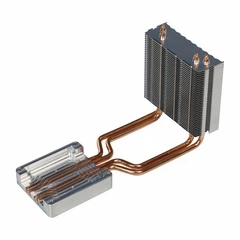
First off, let's talk about what a heat pipe aluminum heat sink is. It's a device that helps dissipate heat from electronic components. The heat pipe is a sealed tube filled with a working fluid that transfers heat from the source to the fins. The fins, on the other hand, increase the surface area of the heat sink, allowing for more efficient heat transfer to the surrounding air.
Now, the fin design of a heat pipe aluminum heat sink can have a significant impact on its heat transfer performance. There are several factors to consider when it comes to fin design, such as fin shape, fin density, and fin material.
Let's start with fin shape. There are various fin shapes available, including straight fins, pin fins, and wavy fins. Straight fins are the most common and are relatively easy to manufacture. They provide a large surface area for heat transfer and are suitable for applications where space is not a constraint. Pin fins, on the other hand, are cylindrical in shape and offer a high surface area-to-volume ratio. They are often used in applications where high heat transfer rates are required, such as in computer processors. Wavy fins are designed to enhance heat transfer by creating turbulence in the airflow, which helps to improve the convective heat transfer coefficient.
Fin density is another important factor to consider. Fin density refers to the number of fins per unit length or area. A higher fin density generally means a larger surface area for heat transfer, which can result in better heat dissipation. However, increasing the fin density also increases the resistance to airflow, which can reduce the convective heat transfer coefficient. Therefore, it's important to find the right balance between fin density and airflow resistance to optimize the heat transfer performance of the heat sink.
The material of the fins also plays a role in heat transfer. Aluminum is a commonly used material for fins due to its high thermal conductivity, low cost, and lightweight. However, other materials such as copper and stainless steel can also be used, depending on the specific application requirements. Copper has a higher thermal conductivity than aluminum, which means it can transfer heat more efficiently. However, it is also more expensive and heavier than aluminum. Stainless steel is a corrosion-resistant material that is often used in applications where the heat sink is exposed to harsh environments.
In addition to fin shape, fin density, and fin material, the orientation of the fins can also affect heat transfer. The fins can be oriented vertically or horizontally, depending on the airflow direction. Vertical fins are generally more effective for natural convection applications, where the airflow is driven by buoyancy forces. Horizontal fins, on the other hand, are more suitable for forced convection applications, where the airflow is provided by a fan or blower.
Now, let's take a look at some real-world examples of how the fin design of a heat pipe aluminum heat sink can impact heat transfer. One example is in the field of telecommunications. Telecommunication equipment generates a significant amount of heat, and efficient heat dissipation is crucial to ensure the reliability and performance of the equipment. Aluminum Heat Pipe Communication Module Heatsink is designed with a specific fin shape and density to optimize heat transfer in telecommunication applications. The fins are designed to provide a large surface area for heat transfer and to enhance the convective heat transfer coefficient by creating turbulence in the airflow.
Another example is in the automotive industry. Automobile engines generate a large amount of heat, and effective cooling is essential to prevent engine overheating. Automobile Car Drainage Raditor is designed with a fin design that is optimized for automotive applications. The fins are designed to provide a high surface area for heat transfer and to withstand the harsh operating conditions of an automotive environment.
Finally, let's consider the energy storage industry. Energy storage batteries generate heat during charging and discharging, and efficient heat dissipation is necessary to ensure the safety and performance of the batteries. Cavity-type Energy Storage Battery Water Cooling Plate is designed with a fin design that is optimized for energy storage applications. The fins are designed to provide a large surface area for heat transfer and to enhance the convective heat transfer coefficient by creating turbulence in the coolant flow.
In conclusion, the fin design of a heat pipe aluminum heat sink has a significant impact on its heat transfer performance. By carefully considering factors such as fin shape, fin density, fin material, and fin orientation, it's possible to optimize the heat transfer performance of the heat sink for specific applications. As a supplier of Heat Pipe Aluminum Heat Sinks, we understand the importance of fin design and offer a wide range of heat sinks with different fin designs to meet the diverse needs of our customers.
If you're in the market for a high-quality heat pipe aluminum heat sink, we'd love to hear from you. Whether you're in the telecommunications, automotive, or energy storage industry, we have the expertise and experience to provide you with the right heat sink solution for your application. Contact us today to discuss your requirements and let's start a conversation about how we can help you with your heat transfer needs.


References
- Incropera, F. P., & DeWitt, D. P. (2002). Fundamentals of heat and mass transfer. Wiley.
- Holman, J. P. (2002). Heat transfer. McGraw-Hill.
- Cengel, Y. A., & Ghajar, A. J. (2015). Heat and mass transfer: fundamentals and applications. McGraw-Hill.