


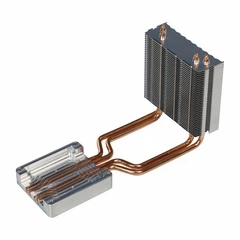
Hey there! As a supplier of water - cooled plate assemblies, I often get asked about the maximum temperature difference across these assemblies. It's a super important topic, especially when you're looking at the efficiency and performance of these cooling solutions.
Let's start with the basics. Water - cooled plate assemblies are used in a wide range of applications, from electronics to automotive systems. Their main job is to transfer heat away from a hot component and dissipate it into the surrounding environment. The temperature difference across the assembly is a key factor in determining how well it can do this job.
The maximum temperature difference across a water - cooled plate assembly depends on several factors. First off, the thermal conductivity of the materials used in the plate is crucial. Most of our water - cooled plates are made from high - quality metals like aluminum. Aluminum has a relatively high thermal conductivity, which means it can transfer heat quickly. You can check out our Aluminum Heat Pipe Communication Module Heatsink for an example of how aluminum is used in our products to enhance heat transfer.
Another factor is the flow rate of the coolant (usually water) through the plate. If the coolant is flowing too slowly, it won't be able to carry away the heat as effectively, and the temperature difference across the plate will be limited. On the other hand, if the flow rate is too high, it might cause excessive pressure drop and energy consumption. So, finding the right balance is essential.
The design of the water channels inside the plate also plays a big role. A well - designed channel can ensure that the coolant comes into contact with all parts of the hot surface, maximizing heat transfer. Our engineers spend a lot of time optimizing these designs to get the best performance.
In automotive applications, water - cooled plate assemblies are used in things like Automobile Car Drainage Raditor. The engine generates a huge amount of heat, and the water - cooled plates help keep the engine at a safe operating temperature. The maximum temperature difference here can be quite significant, sometimes reaching up to 50 - 100 degrees Celsius, depending on the engine's power output and the cooling system's efficiency.
For electronic devices, the temperature difference requirements are usually more stringent. Components like CPUs and GPUs can overheat very quickly, which can lead to reduced performance or even permanent damage. Our Lightweight Automotive Controller Water Cooling Plate is designed to handle these delicate electronic components. In these cases, we aim to keep the temperature difference across the plate within a much smaller range, typically around 10 - 20 degrees Celsius.
To measure the maximum temperature difference, we use a combination of thermocouples and infrared cameras. Thermocouples are placed at different points on the hot surface and in the coolant flow to get accurate temperature readings. Infrared cameras can give us a visual representation of the temperature distribution across the plate, which helps us identify any hot spots or areas where the cooling is not as effective.
We also conduct a lot of testing in our labs to determine the maximum temperature difference under different operating conditions. We simulate real - world scenarios, such as high - load operation for automotive engines or overclocking for electronic devices. This way, we can ensure that our water - cooled plate assemblies can handle the toughest situations.
One of the challenges we face is dealing with different ambient temperatures. In hot climates, the coolant might already be at a relatively high temperature when it enters the plate, which reduces the available temperature difference for heat transfer. To overcome this, we might need to use additional cooling methods, such as air - cooling or refrigeration, in combination with the water - cooled plates.
In conclusion, the maximum temperature difference across water - cooled plate assemblies varies depending on the application, materials, design, and operating conditions. For automotive applications, it can be quite large, while for electronic devices, it needs to be carefully controlled within a smaller range.


If you're in the market for high - quality water - cooled plate assemblies, we'd love to have a chat with you. Whether you're an automotive manufacturer looking to improve your engine cooling or an electronics company in need of a reliable cooling solution for your devices, we've got the expertise and products to meet your needs. Just reach out to us, and we can start discussing your specific requirements and how our products can fit into your projects.
References
- Incropera, F. P., DeWitt, D. P., Bergman, T. L., & Lavine, A. S. (2007). Fundamentals of Heat and Mass Transfer. Wiley.
- Cengel, Y. A., & Ghajar, A. J. (2015). Heat and Mass Transfer: Fundamentals and Applications. McGraw - Hill Education.