


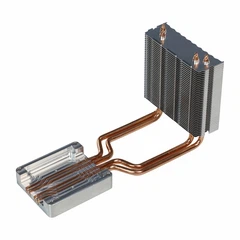
Hey there! As a supplier of all aluminum stacked radiators, I'm super stoked to share with you what these rad devices look like. So, let's dive right in!
The Basics of All Aluminum Stacked Radiators
First off, let's talk about why aluminum is the go - to material for these radiators. Aluminum is lightweight, which is a huge plus, especially in applications where weight matters, like in automotive or aerospace industries. It also has excellent thermal conductivity, meaning it can transfer heat away from the source really efficiently.
An all aluminum stacked radiator is made up of multiple layers or "stacks" of aluminum fins and tubes. These stacks are arranged in a way that maximizes the surface area available for heat transfer. The more surface area, the better the radiator can dissipate heat.
The Physical Appearance
Fins
The fins are one of the most distinctive features of an all aluminum stacked radiator. They are thin, flat pieces of aluminum that are closely spaced. Think of them like the pages in a book, but much thinner and more closely packed. The fins are usually corrugated, which means they have a series of small ridges and valleys. This corrugation serves two main purposes. Firstly, it increases the surface area of the fins, allowing for more heat to be transferred. Secondly, it helps to direct the flow of air or coolant over the fins, improving the overall efficiency of the radiator.
The fins can come in different shapes and sizes depending on the specific application. For example, in a high - performance automotive radiator, the fins might be smaller and more densely packed to maximize heat transfer in a limited space. On the other hand, in an industrial radiator, the fins could be larger and more widely spaced to handle a greater volume of airflow.
Tubes
The tubes in an all aluminum stacked radiator are where the coolant flows. They are typically made of aluminum and are connected to the fins. The tubes are usually arranged in a parallel pattern, allowing the coolant to flow through the radiator in an organized manner.
The shape of the tubes can vary. Some are round, while others are rectangular or oval. Round tubes are often used because they are easy to manufacture and provide a smooth flow path for the coolant. Rectangular or oval tubes, on the other hand, can sometimes offer better heat transfer characteristics because they have a larger surface area in contact with the fins.
Headers
Headers are the parts of the radiator that connect the tubes to the inlet and outlet ports. They are usually made of a thicker piece of aluminum and serve as a distribution point for the coolant. The headers have holes that match up with the ends of the tubes, allowing the coolant to flow in and out of the tubes.


The headers are often welded or brazed to the tubes and fins to create a strong and leak - proof connection. They can also have additional features, such as mounting brackets or bosses, which are used to attach the radiator to the vehicle or equipment.
Overall Structure
When you look at an all aluminum stacked radiator as a whole, it has a very structured and organized appearance. The stacks of fins and tubes are neatly arranged, and the headers provide a clear connection point for the coolant. The radiator is usually enclosed in a frame or housing, which helps to protect the internal components and provides a mounting point for the radiator.
Different Configurations
All aluminum stacked radiators come in a variety of configurations to suit different applications.
Single - Pass vs. Multi - Pass
A single - pass radiator has the coolant flowing through the tubes in one direction only. This is a simple and cost - effective design that is suitable for many applications. However, in some cases, a multi - pass radiator might be required. In a multi - pass radiator, the coolant flows through the tubes in multiple directions, which can increase the overall heat transfer efficiency. For example, a two - pass radiator will have the coolant flow through the tubes in one direction, then reverse direction and flow through another set of tubes.
Size and Shape
All aluminum stacked radiators can come in all sorts of sizes and shapes. They can be small and compact, like the ones used in laptop cooling systems, or large and bulky, like those used in power plants. The shape can also vary depending on the available space and the specific requirements of the application. Some radiators are rectangular, while others might be circular or have a custom shape.
Related Products
If you're interested in all aluminum stacked radiators, you might also want to check out some of our other related products. We offer a Combination Water Cooling Radiator that combines the benefits of water cooling with the efficiency of an aluminum radiator. It's a great option for applications where you need to cool multiple components.
Another product is the Controllable Power Water Cooling Plate. This plate is designed to provide precise cooling control, making it ideal for applications where temperature regulation is critical.
We also have the DCC Power Control High - Power Heatsink, which is specifically designed to handle high - power applications. It's a robust and reliable solution for cooling high - performance electronics.
Why Choose Our All Aluminum Stacked Radiators
As a supplier, we take pride in offering high - quality all aluminum stacked radiators. Our radiators are manufactured using the latest technology and the highest quality materials. We have a team of experienced engineers who can customize the radiators to meet your specific requirements.
We understand that every application is different, and that's why we offer a wide range of options in terms of size, shape, and performance. Whether you need a small radiator for a consumer electronics device or a large radiator for an industrial application, we've got you covered.
Let's Connect
If you're in the market for an all aluminum stacked radiator or any of our related products, I'd love to hear from you. Whether you have questions about the appearance, performance, or pricing, don't hesitate to reach out. We're here to help you find the perfect radiator solution for your needs. So, let's start a conversation and see how we can work together to keep your systems cool!
References
- "Heat Transfer in Radiators" - Thermal Engineering Handbook
- "Aluminum Alloys for Radiator Applications" - Journal of Materials Science