


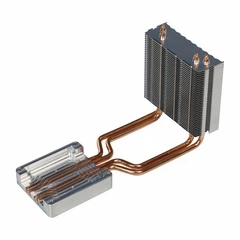
Hey there! As a supplier of water-cooled plate assemblies, I'm super stoked to share with you the main components that make these assemblies tick. Water-cooled plate assemblies are crucial in a bunch of industries, from automotive to electronics, 'cause they're all about keeping things cool and running smoothly. So, let's dive right in and check out what goes into these bad boys.
Base Plate
The base plate is like the foundation of the water-cooled plate assembly. It's the part that comes into direct contact with the heat source, whether it's a high - performance CPU in a computer or a power electronics module in a car. This plate needs to be made of a material that's a great conductor of heat. Metals like copper and aluminum are the top choices here.
Copper is an absolute beast when it comes to heat conduction. It can quickly transfer heat away from the source and into the cooling system. But it's also a bit heavy and more expensive compared to aluminum. Aluminum, on the other hand, is lighter and more affordable. It still has decent heat - conducting properties, and it's widely used in many water - cooled plate applications. For example, our Automotive Controller Water Cooling Plate often uses an aluminum base plate due to its cost - effectiveness and light weight, which is super important in the automotive industry.
Channels or Passages
Inside the water - cooled plate, there are channels or passages where the coolant flows. These channels are designed in a way that maximizes the contact between the coolant and the base plate, allowing for efficient heat transfer. There are different types of channel designs.
One common design is the straight - channel design. It's simple and easy to manufacture. The coolant flows in a straight line through the channels, picking up heat from the base plate as it goes. Another design is the serpentine or zig - zag channel. This design increases the path length of the coolant, giving it more time to absorb heat. It also helps to distribute the coolant evenly across the base plate.


In some high - performance applications, we use micro - channels. These are tiny channels with a very small cross - sectional area. Micro - channels can provide a large surface area for heat transfer, which means they can cool things down really quickly. Our Cavity - type Energy Storage Battery Water Cooling Plate might use micro - channels to ensure efficient cooling of the energy storage batteries.
Coolant
The coolant is the fluid that circulates through the channels of the water - cooled plate to absorb and carry away the heat. Water is the most commonly used coolant because it's cheap, readily available, and has good heat - absorbing properties. However, pure water has some drawbacks. It can corrode the metal components of the water - cooled plate over time, and it freezes at 0°C, which can be a problem in cold environments.
To overcome these issues, we often use a mixture of water and ethylene glycol or propylene glycol. These additives lower the freezing point of the coolant and also act as anti - corrosion agents. They help to protect the internal components of the water - cooled plate and ensure its long - term reliability.
Seals and Gaskets
Seals and gaskets are essential components of water - cooled plate assemblies. Their job is to prevent the coolant from leaking out of the channels. They create a tight seal between different parts of the assembly, such as the base plate and the cover.
We use different types of seals and gaskets depending on the application. Rubber seals are common because they're flexible and can conform to the shape of the mating surfaces. They can also withstand a certain amount of pressure and temperature changes. For more demanding applications, we might use silicone gaskets. Silicone has better heat resistance and chemical resistance compared to rubber, making it suitable for high - temperature and harsh - environment applications.
Connectors
Connectors are used to connect the water - cooled plate assembly to the rest of the cooling system. They allow the coolant to flow in and out of the assembly. There are different types of connectors, such as quick - connect fittings and threaded connectors.
Quick - connect fittings are really convenient. They can be easily connected and disconnected without the need for tools. This makes maintenance and installation a breeze. Threaded connectors, on the other hand, provide a more secure connection. They're often used in applications where there's high pressure or vibration, as they can prevent the connector from coming loose.
Heat Pipes (Optional)
In some advanced water - cooled plate assemblies, we use heat pipes. Heat pipes are highly efficient heat transfer devices. They work by using a phase - change process. Inside the heat pipe, there's a small amount of working fluid. When the heat pipe comes into contact with a heat source, the working fluid evaporates. The vapor then moves to the cooler end of the heat pipe, where it condenses and releases the heat.
Heat pipes can significantly enhance the heat transfer performance of the water - cooled plate assembly. They can quickly transfer heat from hot spots to the coolant channels, improving the overall cooling efficiency. For example, our Aluminum Heat Pipe Communication Module Heatsink uses heat pipes to effectively cool communication modules, which generate a lot of heat during operation.
Monitoring and Control Components (Optional)
In more sophisticated water - cooled plate systems, we might include monitoring and control components. These can include temperature sensors, flow sensors, and valves.
Temperature sensors are used to measure the temperature of the coolant and the heat source. They provide real - time data that can be used to adjust the cooling system's operation. Flow sensors, on the other hand, measure the flow rate of the coolant. This information is important to ensure that the coolant is flowing at the right rate to maintain efficient cooling.
Valves are used to control the flow of the coolant. They can be adjusted to increase or decrease the coolant flow based on the temperature and other operating conditions. For example, if the temperature of the heat source rises, the valve can be opened wider to allow more coolant to flow through the water - cooled plate.
Conclusion
So, there you have it! These are the main components of water - cooled plate assemblies. Each component plays a crucial role in ensuring the efficient and reliable operation of the cooling system. Whether you're in the automotive, electronics, or any other industry that requires effective heat management, a well - designed water - cooled plate assembly can make a huge difference.
If you're interested in our water - cooled plate assemblies or have any questions about them, don't hesitate to reach out. We're always ready to have a chat and discuss how our products can meet your specific needs. Let's work together to find the perfect cooling solution for your application.
References
- Incropera, F. P., DeWitt, D. P., Bergman, T. L., & Lavine, A. S. (2007). Fundamentals of Heat and Mass Transfer. Wiley.
- ASHRAE Handbook: HVAC Systems and Equipment. (2012). American Society of Heating, Refrigerating and Air - Conditioning Engineers.