


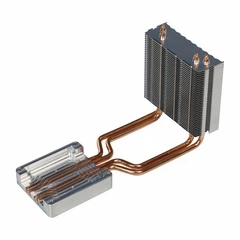
When it comes to thermal management, Black Skived Toothed Heat Sinks are a popular solution, especially in high - performance applications. As a supplier of Black Skived Toothed Heat Sinks, I've witnessed firsthand the importance of understanding every aspect of these products to meet the diverse needs of our customers. One crucial aspect that often gets overlooked is the effect of tooth spacing on pressure drop.
Fundamentals of Black Skived Toothed Heat Sinks
Black Skived Toothed Heat Sinks are known for their excellent thermal conductivity and high - surface - area design. Skiving is a manufacturing process that creates thin, fin - like teeth on the heat sink. These teeth significantly increase the surface area available for heat transfer, allowing for more efficient cooling. The black coating on the heat sink not only gives it an aesthetically pleasing look but also enhances its emissivity, further improving heat dissipation.
The Concept of Pressure Drop
Pressure drop is a critical parameter in heat sink design. In the context of a heat sink, it refers to the decrease in pressure of the cooling fluid (usually air) as it passes through the heat sink. A high - pressure drop means that more energy is required to move the cooling fluid through the heat sink. This has several implications. Firstly, it can increase the power consumption of the cooling system, as fans or pumps need to work harder. Secondly, it can limit the flow rate of the cooling fluid, which in turn can affect the overall heat transfer performance of the heat sink.


Impact of Tooth Spacing on Pressure Drop
Narrow Tooth Spacing
When the teeth on the Black Skived Toothed Heat Sink are closely spaced, the flow passages for the cooling fluid become narrower. This creates more resistance to the flow of air, resulting in a higher pressure drop. The narrow passages force the air to flow through a more restricted area, causing the air molecules to collide more frequently with the tooth surfaces. These collisions dissipate energy, leading to a decrease in pressure.
On one hand, narrow tooth spacing can increase the heat transfer coefficient. The increased surface area per unit volume due to the closely - spaced teeth allows for more efficient heat transfer from the heat sink to the air. However, the high - pressure drop associated with narrow tooth spacing can limit the air flow rate. If the pressure drop is too high, the fan may not be able to deliver enough air to remove the heat effectively, leading to a decrease in the overall cooling performance.
For applications where space is limited and heat transfer density is high, such as in DCC Power Control Stacked Dual - Sided Heatsink, narrow tooth spacing may be a viable option. But careful consideration must be given to the fan's ability to overcome the pressure drop.
Wide Tooth Spacing
Conversely, when the tooth spacing is wide, the flow passages for the air are broader. This results in less resistance to the air flow, and thus a lower pressure drop. The air can move more freely through the heat sink, requiring less energy from the fan.
However, wide tooth spacing means that the surface area per unit volume is reduced. This can lead to a lower heat transfer coefficient compared to a heat sink with narrow tooth spacing. The wider passages may also cause the air to flow around the heat sink without effectively interacting with all the tooth surfaces, reducing the overall heat transfer efficiency.
In applications where there is more available space and a lower heat transfer density, such as in Combination Aluminum Water Cooling Radiator, wide tooth spacing might be more appropriate. The lower pressure drop allows for a higher air flow rate, which can compensate for the lower heat transfer coefficient.
Experimental Evidence and Case Studies
Several studies have been conducted to quantify the relationship between tooth spacing and pressure drop in Black Skived Toothed Heat Sinks. For instance, a research group carried out experiments using different heat sink models with varying tooth spacings. They measured the pressure drop across the heat sink while maintaining a constant air flow rate. The results showed a clear trend: as the tooth spacing decreased, the pressure drop increased exponentially.
In a real - world case study, a customer in the electronics industry was facing issues with overheating in their laser module. They initially used a heat sink with wide tooth spacing, but the cooling performance was not sufficient. After consulting with our team, we recommended a heat sink with narrower tooth spacing. While the pressure drop increased, we also provided a more powerful fan to ensure adequate air flow. The new setup significantly improved the cooling performance of the laser module, similar to how an Air - Cooled Laser Module Heatsink should perform optimally.
Optimizing Tooth Spacing for Different Applications
Choosing the right tooth spacing for a Black Skived Toothed Heat Sink depends on a variety of factors. These include the available space, the heat transfer requirements, the power of the cooling system, and the allowable pressure drop.
For high - power applications where heat density is extremely high, a compromise between pressure drop and heat transfer coefficient needs to be made. A slightly wider tooth spacing than the minimum possible can be used to reduce the pressure drop without sacrificing too much heat transfer performance. Additionally, using high - performance fans or enhancing the air flow path can help overcome the pressure drop.
In low - power applications, where heat generation is relatively low, wide tooth spacing is usually the best option. This allows for a low - cost, energy - efficient cooling solution with minimal pressure drop.
Conclusion and Call to Action
In conclusion, the tooth spacing of a Black Skived Toothed Heat Sink has a profound effect on the pressure drop, which in turn impacts the overall cooling performance and energy consumption of the system. As a supplier, we understand the complexity of these relationships and are committed to providing our customers with the best - suited heat sink solutions.
Whether you are working on a high - power electronics project or a low - power cooling application, we have the expertise and product range to meet your needs. Our team of engineers can help you select the optimal tooth spacing for your specific requirements, ensuring maximum heat transfer efficiency and minimum energy consumption.
If you are interested in learning more about our Black Skived Toothed Heat Sinks or would like to discuss a potential purchase, we encourage you to reach out. We are ready to engage in in - depth discussions and provide you with detailed product information and technical support. Let's work together to find the perfect thermal management solution for your project.
References
- Incropera, F. P., & DeWitt, D. P. (2002). Fundamentals of Heat and Mass Transfer. John Wiley & Sons.
- Kays, W. M., & Crawford, M. E. (1993). Convective Heat and Mass Transfer. McGraw - Hill.
- Various industry - specific research papers on heat sink design and performance.