


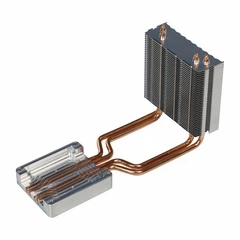
Hey there! As a supplier of car brand radiators, I've been getting a lot of questions lately about whether a radiator can be used as a heat exchanger in other applications for a car brand. Well, let's dive right into it and see what we can find out.
First off, let's talk about what a radiator actually does. A radiator is a key component in a car's cooling system. Its main job is to transfer heat from the hot coolant that flows through the engine to the surrounding air. This helps keep the engine at the right temperature, preventing it from overheating and causing all sorts of problems.
But can it be used in other applications? The short answer is yes, it can. Radiators are essentially heat exchangers, and heat exchangers are used in a wide range of applications to transfer heat from one fluid to another. In the context of a car brand, there are several other areas where a radiator could potentially be used as a heat exchanger.
One possible application is in the cooling of automotive controllers. These controllers are responsible for managing various systems in the car, like the engine control unit, transmission control unit, and more. They generate a fair amount of heat during operation, and effective cooling is crucial to ensure their proper functioning. A Lightweight Automotive Controller Water Cooling Plate could be used here. It's designed to efficiently transfer heat away from the controller, much like a radiator does for the engine.
Another area is the cooling of energy storage batteries. With the rise of electric and hybrid cars, the importance of battery cooling has increased significantly. Batteries can generate a lot of heat during charging and discharging, and if not properly cooled, it can lead to reduced battery life and performance. A Cavity-type Energy Storage Battery Water Cooling Plate can act as a heat exchanger to keep the batteries at an optimal temperature.
Communication modules in cars also need cooling. These modules are responsible for things like in - car infotainment, connectivity, and driver assistance systems. As they become more advanced, they generate more heat. An Aluminum Heat Pipe Communication Module Heatsink can be used to transfer the heat away, and in a way, it functions similar to a radiator.
Now, let's look at the advantages of using a radiator as a heat exchanger in these applications. One of the biggest advantages is the cost - effectiveness. Since radiators are mass - produced for car engines, they are relatively inexpensive compared to some specialized heat exchangers. Also, they are well - tested and proven to be reliable in transferring heat.
Another advantage is the availability of parts. As a car brand radiator supplier, I know that there are a large number of radiator parts available in the market. This means that if there is a problem with the heat exchanger, it's easier to find replacement parts.
However, there are also some challenges. One of the main challenges is the space constraint. In some of these applications, there may not be enough space to fit a full - sized radiator. So, modifications may be needed to make it work. Also, the heat transfer requirements may be different in these applications compared to the engine cooling. For example, the coolant flow rate and the temperature range may vary.


To overcome these challenges, we need to do some customization. We can design radiators with different sizes and shapes to fit into the available space. We can also adjust the coolant flow and the heat transfer surface area to meet the specific requirements of each application.
In conclusion, a radiator can definitely be used as a heat exchanger in other applications for a car brand. It offers cost - effectiveness, reliability, and easy availability of parts. But it also requires some customization to work well in different applications.
If you're interested in exploring the use of radiators as heat exchangers for your car brand's specific applications, I'd love to have a chat with you. We can discuss your requirements and see how we can provide the best solutions. Whether it's for automotive controllers, energy storage batteries, or communication modules, we've got the expertise to help you out.
Let's have a talk and see how we can make your car's systems run more efficiently and reliably.
References
- General automotive engineering textbooks on cooling systems and heat exchangers.
- Industry reports on the use of heat exchangers in automotive applications.