


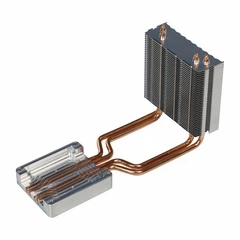
Hey there! As a supplier of Circular Base LED Heat Sinks, I've seen a lot of questions from customers about how different factors affect heat dissipation. One question that comes up quite often is, "How does the number of fins on a circular base LED heat sink impact heat dissipation?" Well, let's dive right in and explore this topic.
The Basics of Heat Dissipation
Before we talk about the fins, let's quickly go over how heat dissipation works. When an LED is in use, it generates heat. If this heat isn't dissipated properly, it can lead to a decrease in the LED's performance and lifespan. That's where heat sinks come in. A heat sink's job is to absorb the heat from the LED and transfer it to the surrounding air.
The main way heat is transferred from the heat sink to the air is through convection. Convection occurs when the warm air around the heat sink rises and is replaced by cooler air. This continuous cycle helps to carry the heat away from the heat sink.
The Role of Fins in Heat Dissipation
Fins are an essential part of a heat sink. They increase the surface area of the heat sink, which allows for more contact between the heat sink and the surrounding air. The more surface area there is, the more heat can be transferred from the heat sink to the air through convection.
Think of it like this: if you have a flat piece of metal and a piece of metal with fins, the one with fins has a lot more area for the air to touch. So, it can transfer heat more effectively.


Impact of the Number of Fins on Heat Dissipation
Now, let's get to the main question: how does the number of fins impact heat dissipation?
More Fins, More Surface Area
In general, increasing the number of fins on a circular base LED heat sink increases the surface area. As we mentioned earlier, more surface area means more contact with the air, which leads to better heat dissipation. So, if you have a heat sink with a lot of fins, it can transfer more heat to the air compared to a heat sink with fewer fins.
For example, let's say we have two circular base LED heat sinks with the same base size. One has 10 fins, and the other has 20 fins. The heat sink with 20 fins will have a larger surface area, and it will be able to dissipate heat more efficiently.
However, There Are Limits
While more fins usually mean better heat dissipation, there are limits to this. If you add too many fins, it can actually have a negative impact on heat dissipation.
One problem is that as the number of fins increases, the space between the fins decreases. This can restrict the airflow between the fins. If the airflow is restricted, the warm air can't rise and be replaced by cooler air as easily. As a result, the heat transfer rate can decrease.
Another issue is that adding more fins also increases the weight and cost of the heat sink. So, you need to find a balance between the number of fins and the performance you want.
Finding the Optimal Number of Fins
So, how do you find the optimal number of fins for a circular base LED heat sink? Well, it depends on several factors.
LED Power
The power of the LED is an important factor. Higher-power LEDs generate more heat, so they usually require a heat sink with more fins to dissipate the heat effectively. For example, a high-power LED might need a heat sink with 30 or more fins, while a low-power LED might only need 10 - 15 fins.
Airflow Conditions
The airflow conditions around the heat sink also matter. If there is good natural convection or forced airflow (e.g., from a fan), you might be able to get away with fewer fins. On the other hand, if the airflow is limited, you might need more fins to increase the surface area and improve heat dissipation.
Size Constraints
The size of the heat sink can also limit the number of fins. If you have a small circular base, you won't be able to fit as many fins as you would on a larger base. So, you need to consider the available space when choosing the number of fins.
Our Circular Base LED Heat Sinks
At our company, we offer a wide range of Circular Base LED Heat Sinks with different numbers of fins to meet your specific needs. Whether you're looking for a heat sink for a low-power LED or a high-power one, we've got you covered.
We also have other related products that you might be interested in. For example, we have the Semiconductor Cooling Module Heatsink, which is great for semiconductor applications. And if you're looking for an aluminum cooling module, check out our Semiconductor Aluminum Cooling Module Heatsink. We also offer the High-Power Combined LED Heat Sink for high-power LED setups.
Conclusion
In conclusion, the number of fins on a circular base LED heat sink plays a crucial role in heat dissipation. While more fins generally mean better heat dissipation due to increased surface area, there are limits, and you need to consider factors like LED power, airflow conditions, and size constraints.
If you're in the market for a Circular Base LED Heat Sink or any of our other products, don't hesitate to contact us for a purchase negotiation. We're here to help you find the best heat sink solution for your needs.
References
- Incropera, F. P., DeWitt, D. P., Bergman, T. L., & Lavine, A. S. (2007). Fundamentals of Heat and Mass Transfer. John Wiley & Sons.
- Holman, J. P. (2010). Heat Transfer. McGraw-Hill.