


Hey there! As a supplier of Circular Base LED Heat Sinks, I've spent a ton of time thinking about how air flow around these heat sinks impacts their performance. Let's dive right in and break it down.
First off, let's understand what a Circular Base LED Heat Sink is. It's a crucial component in LED lighting systems. LEDs generate heat, and if that heat isn't managed properly, it can lead to reduced lifespan, color shifting, and even complete failure of the LED. That's where our Circular Base LED Heat Sinks come in. They're designed to absorb and dissipate the heat generated by the LEDs, keeping them cool and running efficiently.
Now, let's talk about air flow. Air flow plays a huge role in how well a heat sink works. When air moves around the heat sink, it carries away the heat that the heat sink has absorbed from the LEDs. This process is called convection. There are two main types of convection: natural and forced.
Natural convection occurs when the air around the heat sink is heated by the heat sink itself. The heated air becomes less dense and rises, creating a flow of air that carries away the heat. This is a passive process and doesn't require any additional energy. However, natural convection can be limited, especially in enclosed spaces or when the heat load is high.
On the other hand, forced convection involves using a fan or other device to move air around the heat sink. This can significantly increase the rate of heat transfer, making the heat sink more effective. Forced convection is often used in high-power LED applications where natural convection isn't enough to keep the LEDs cool.
So, how does the air flow around a Circular Base LED Heat Sink affect its performance? Well, it all comes down to the surface area of the heat sink that is exposed to the air flow. The more surface area that is exposed, the more heat can be transferred from the heat sink to the air.
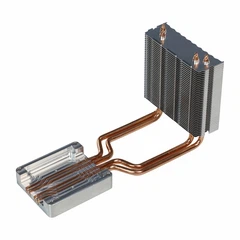
A well-designed Circular Base LED Heat Sink will have fins or other structures that increase its surface area. These fins create channels for the air to flow through, allowing the air to come into contact with more of the heat sink's surface. This increases the rate of heat transfer and improves the performance of the heat sink.
However, the shape and arrangement of the fins also matter. If the fins are too close together, the air flow can be restricted, reducing the effectiveness of the heat sink. On the other hand, if the fins are too far apart, the surface area available for heat transfer is reduced. Finding the right balance is crucial for optimizing the performance of the heat sink.
Another factor to consider is the direction of the air flow. The air should flow in a way that maximizes the contact between the air and the heat sink's surface. For example, if the air is flowing parallel to the fins, it may not be able to reach all of the surface area of the heat sink. In this case, a perpendicular air flow may be more effective.
In addition to the shape and arrangement of the fins, the material of the heat sink also affects its performance. Most Circular Base LED Heat Sinks are made of aluminum because it has good thermal conductivity and is relatively lightweight. However, other materials such as copper can also be used, especially in high-power applications where higher thermal conductivity is required.
The air flow around a Circular Base LED Heat Sink can also be affected by the surrounding environment. For example, if the heat sink is installed in a tight space, the air flow may be restricted, reducing its performance. In this case, it may be necessary to use a fan or other device to improve the air flow.
Now, let's take a look at some of the other products we offer. We also supply High-power Aluminum Laser Heatsink, which are designed to dissipate the heat generated by high-power lasers. These heat sinks are made of high-quality aluminum and are designed to provide efficient heat transfer.
We also have High-power Air-cooled Laser Heatsink. These heat sinks use forced convection to cool the lasers, making them ideal for high-power applications where natural convection isn't enough.


And if you're looking for a water-cooling solution, we offer Versatile Water Cooling Plate. These plates are designed to provide efficient heat transfer using water as a coolant.
In conclusion, the air flow around a Circular Base LED Heat Sink is crucial for its performance. By understanding how air flow affects heat transfer, we can design and manufacture heat sinks that are more effective at keeping LEDs cool. Whether you're using natural or forced convection, a well-designed heat sink with the right shape, material, and surface area can make a big difference in the performance of your LED lighting system.
If you're interested in learning more about our Circular Base LED Heat Sinks or any of our other products, feel free to reach out to us. We're always happy to discuss your specific needs and help you find the right solution for your application.
References
- Incropera, F. P., & DeWitt, D. P. (2002). Fundamentals of Heat and Mass Transfer. John Wiley & Sons.
- Holman, J. P. (2002). Heat Transfer. McGraw-Hill.