


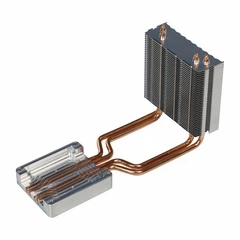
As a supplier of water - cooled plate assemblies, I've had numerous in - depth discussions with customers about the concept of temperature uniformity in these assemblies. Temperature uniformity is a critical aspect that significantly impacts the performance, efficiency, and lifespan of various systems that rely on water - cooled plate assemblies.


Understanding Temperature Uniformity
Temperature uniformity refers to the degree to which the temperature is consistent across the surface of a water - cooled plate assembly. In an ideal scenario, every point on the cooling plate would have the same temperature. However, in real - world applications, achieving perfect temperature uniformity is extremely challenging due to several factors.
One of the primary factors affecting temperature uniformity is the flow pattern of the coolant within the water - cooled plate. The coolant, typically water or a water - based mixture, absorbs heat from the heat - generating components and transfers it away. If the coolant flow is uneven, some areas of the plate may receive more coolant than others. For example, in a plate with a complex internal channel design, coolant may flow more easily through wider or straighter channels, leaving other regions with less efficient cooling. This can result in hotspots on the plate, where the temperature is significantly higher than in other areas.
Another factor is the thermal conductivity of the materials used in the water - cooled plate. Different materials have different abilities to conduct heat. Aluminum is a commonly used material in water - cooled plate assemblies because of its relatively high thermal conductivity, lightweight, and cost - effectiveness. However, even with high - quality aluminum, variations in the material's microstructure or the presence of impurities can affect its thermal conductivity, leading to non - uniform temperature distribution.
The heat load distribution from the heat - generating components also plays a crucial role. In many applications, such as automotive controllers or high - power electronics, the heat is not evenly generated across the surface. Some components may dissipate more heat than others, creating a non - uniform heat source. If the water - cooled plate is not designed to handle this uneven heat load, it can lead to poor temperature uniformity.
Importance of Temperature Uniformity in Water - Cooled Plate Assemblies
The importance of temperature uniformity cannot be overstated. In electronic systems, high temperatures can cause components to degrade more quickly, leading to reduced performance and a shorter lifespan. For example, in automotive controllers, which are responsible for managing various functions in a vehicle, overheating can result in malfunctions, affecting the safety and reliability of the vehicle. A water - cooled plate assembly with good temperature uniformity helps to keep all components within a safe operating temperature range, ensuring consistent performance and long - term durability.
In addition, temperature uniformity can improve the efficiency of the cooling system itself. When the temperature is evenly distributed across the plate, the coolant can absorb heat more effectively. This means that less coolant is required to achieve the same level of cooling, reducing energy consumption and potentially lowering the cost of operation.
Measuring Temperature Uniformity
To assess the temperature uniformity of a water - cooled plate assembly, several methods can be used. One common approach is to use thermal imaging cameras. These cameras can capture the temperature distribution across the surface of the plate in real - time, allowing engineers to identify hotspots and areas of non - uniform cooling. By analyzing the thermal images, adjustments can be made to the design of the plate or the coolant flow to improve temperature uniformity.
Another method is to use temperature sensors placed at various points on the plate. These sensors can provide accurate temperature readings at specific locations, enabling a more detailed analysis of the temperature distribution. By comparing the readings from different sensors, engineers can quantify the degree of temperature non - uniformity and make informed decisions about design improvements.
Improving Temperature Uniformity in Water - Cooled Plate Assemblies
As a supplier, we take several steps to improve the temperature uniformity of our water - cooled plate assemblies. First, we focus on the design of the internal channel structure. Through advanced computational fluid dynamics (CFD) simulations, we can optimize the channel layout to ensure a more even coolant flow. This may involve adjusting the width, length, and shape of the channels to balance the flow resistance and promote uniform coolant distribution.
We also pay close attention to the selection of materials. By using high - purity aluminum and ensuring strict quality control during the manufacturing process, we can minimize variations in thermal conductivity. Additionally, we may apply surface treatments or coatings to enhance the heat transfer properties of the plate, further improving temperature uniformity.
In cases where the heat load is non - uniform, we design the water - cooled plate to be more responsive to the specific heat distribution. For example, we may increase the coolant flow rate in areas with higher heat loads or use additional heat - spreading structures to distribute the heat more evenly across the plate.
Applications of Water - Cooled Plate Assemblies with Good Temperature Uniformity
Our water - cooled plate assemblies with excellent temperature uniformity find applications in a wide range of industries. In the automotive sector, they are used in Automotive Controller Water Cooling Plate to ensure the reliable operation of vehicle control systems. The lightweight and efficient cooling provided by our plates are particularly beneficial in modern electric and hybrid vehicles, where weight reduction and energy efficiency are crucial.
We also offer Lightweight Automotive Controller Water Cooling Plate for applications where weight is a major concern. These plates are designed to provide high - performance cooling with minimal added weight, making them ideal for use in high - performance vehicles.
In the automotive radiator market, our Automobile Car Drainage Raditor with good temperature uniformity helps to maintain the optimal operating temperature of the engine, improving its efficiency and reducing the risk of overheating.
Conclusion
Temperature uniformity is a key factor in the performance and reliability of water - cooled plate assemblies. As a supplier, we are committed to providing high - quality products with excellent temperature uniformity through advanced design, material selection, and manufacturing processes. Our water - cooled plate assemblies are suitable for a variety of applications, from automotive controllers to high - power electronics.
If you are in the market for water - cooled plate assemblies and are interested in learning more about our products, we encourage you to contact us for a detailed discussion. We can provide customized solutions based on your specific requirements and help you achieve the best cooling performance for your systems.
References
- Incropera, F. P., & DeWitt, D. P. (2002). Fundamentals of Heat and Mass Transfer. John Wiley & Sons.
- Holman, J. P. (2010). Heat Transfer. McGraw - Hill.
- Kakac, S., & Pramuanjaroenkij, A. (2005). Handbook of Single - Phase Convective Heat Transfer. John Wiley & Sons.