


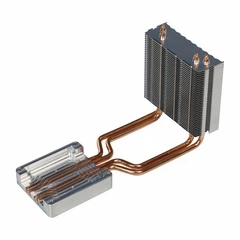
Hey there! As a supplier of Aluminum Finned Heat Sink, I often get asked if it's possible to boost the heat dissipation of these heat sinks by adding more fins. It's a question that's been on the minds of many engineers, hobbyists, and anyone dealing with heat management. So, let's dive right in and explore this topic.
First off, let's understand how an aluminum finned heat sink works. The basic principle is pretty straightforward. Heat is transferred from a hot component (like a CPU or a power transistor) to the base of the heat sink. From there, the heat spreads out across the base and then moves up into the fins. The fins increase the surface area of the heat sink, allowing more heat to be transferred to the surrounding air. This process is called convection, where the warm air near the fins rises and is replaced by cooler air, creating a continuous flow that helps dissipate heat.
Now, the idea of adding more fins seems logical at first glance. More fins mean more surface area, right? And more surface area should mean better heat dissipation. Well, it's not that simple. While it's true that increasing the surface area can enhance heat transfer, there are a few factors that come into play.
One of the main factors is the spacing between the fins. If you pack too many fins too closely together, it can create what's called a "fin effect." This means that the air flow between the fins gets restricted. When the air can't flow freely, it can't carry away the heat effectively. Instead, it can create a boundary layer of warm air around the fins, which acts as an insulator and reduces the overall heat transfer rate. So, even though you've increased the surface area, the heat dissipation might not improve as expected.
Another factor is the material and thickness of the fins. Aluminum is a great choice for heat sinks because it has good thermal conductivity. However, if the fins are too thin, they might not be able to transfer heat efficiently from the base to the tip. On the other hand, if they're too thick, they can add unnecessary weight and cost without a significant increase in heat dissipation.
Let's talk about some real - world scenarios. In a high - speed airflow environment, like in a computer with a powerful fan, adding more fins might have a better chance of improving heat dissipation. The strong airflow can overcome the resistance caused by closely spaced fins and carry away the heat. But in a low - airflow environment, such as a small enclosed space, adding more fins could actually make things worse.
To illustrate this, let's take a look at some research. A study by some experts in the field found that in a low - airflow setup, increasing the number of fins beyond a certain point actually decreased the heat transfer coefficient. This shows that there's an optimal number of fins for different applications.
Now, let's consider the cost - benefit analysis. Adding more fins means more material, more manufacturing time, and potentially more cost. If the increase in heat dissipation doesn't justify the additional cost, then it might not be a practical solution.
But don't get me wrong. There are situations where adding more fins can be beneficial. For example, in a Combination Aluminum Water Cooling Radiator, the water flow can help enhance the heat transfer, and adding more fins can further increase the overall heat dissipation. Similarly, in an Air - Cooled Laser Module Heatsink, where precise heat management is crucial, carefully designed additional fins can make a difference.
So, is it possible to increase the heat dissipation of an aluminum finned heat sink by adding more fins? The answer is yes, but with a big "if." If the airflow, fin spacing, and other factors are carefully considered, adding more fins can improve heat dissipation. But if these factors are ignored, it could lead to a less effective heat sink.
As a supplier, we understand the importance of finding the right balance. We have a team of experts who can analyze your specific requirements and design a heat sink that maximizes heat dissipation while keeping costs in check. Whether you're working on a small DIY project or a large - scale industrial application, we can provide you with the best Aluminum Finned Heat Sink solutions.
If you're interested in learning more about our heat sinks or have a specific heat management problem you need to solve, don't hesitate to reach out. We're here to help you find the perfect heat sink for your needs. Contact us to start a discussion about your project and let's work together to find the best solution.


In conclusion, while adding more fins to an aluminum finned heat sink can potentially increase heat dissipation, it's a complex issue that requires careful consideration of various factors. But with the right design and expertise, we can make it work for you.
References:
- "Heat Transfer in Finned Surfaces" - Journal of Thermal Engineering
- "Effect of Fin Geometry on Heat Sink Performance" - International Journal of Heat and Mass Transfer