


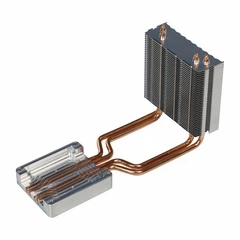
Yo, folks! As a supplier of Aluminum Finned Heat Sinks, I've seen firsthand how crucial it is to understand the relationship between the heat source size and the selection of the right heat sink. In this blog, I'm gonna break down this relationship and share some insights to help you make the best choice for your cooling needs.
Why Heat Source Size Matters
First off, let's talk about why the size of the heat source is such a big deal. The heat source is the component that generates heat, like a CPU in a computer or a power transistor in an electronic device. The amount of heat it produces directly affects the performance and lifespan of the device. If the heat isn't dissipated properly, it can lead to overheating, which can cause malfunctions, reduced efficiency, and even permanent damage.
The size of the heat source plays a key role in determining how much heat needs to be removed. A larger heat source generally produces more heat, so it requires a more powerful heat sink to keep it cool. On the other hand, a smaller heat source may not need as much cooling capacity, so a smaller or less powerful heat sink might be sufficient.
How Heat Source Size Affects Heat Sink Selection
Now that we understand why heat source size matters, let's dive into how it affects the selection of an aluminum finned heat sink. There are several factors to consider, including the heat sink's surface area, fin density, and material.
Surface Area
The surface area of a heat sink is one of the most important factors in determining its cooling efficiency. A larger surface area allows for more heat to be transferred from the heat source to the surrounding air. When the heat source is larger, you'll need a heat sink with a larger surface area to effectively dissipate the heat. This can be achieved by using a heat sink with more fins or larger fins.
For example, if you have a high-power CPU that generates a lot of heat, you might need a heat sink with a large number of thin fins to increase the surface area. On the other hand, if you have a smaller heat source, like a low-power LED, a heat sink with fewer or shorter fins might be enough.
Fin Density
Fin density refers to the number of fins per unit length on the heat sink. A higher fin density means more fins are packed into a smaller space, which can increase the surface area and improve the cooling efficiency. However, there's a trade-off. If the fin density is too high, it can restrict the airflow through the heat sink, which can actually reduce the cooling performance.
When selecting a heat sink based on the heat source size, you need to find the right balance between fin density and airflow. For larger heat sources, you may need a heat sink with a higher fin density to increase the surface area. But you also need to make sure there's enough space between the fins for the air to flow freely.
Material
Aluminum is a popular choice for heat sinks because it's lightweight, has good thermal conductivity, and is relatively inexpensive. However, not all aluminum is created equal. The quality and purity of the aluminum can affect its thermal performance.
When dealing with larger heat sources, you might want to consider using a heat sink made from high-quality aluminum with a higher thermal conductivity. This can help transfer the heat more efficiently from the heat source to the fins and then to the surrounding air.
Matching the Heat Sink to the Heat Source
So, how do you actually match the right aluminum finned heat sink to your heat source? Here are some steps you can follow:
Step 1: Determine the Heat Output
The first step is to figure out how much heat the heat source generates. This can usually be found in the datasheet of the component. The heat output is typically measured in watts (W). Once you know the heat output, you can use it as a starting point to select a heat sink with the appropriate cooling capacity.


Step 2: Consider the Mounting Space
You also need to consider the available mounting space for the heat sink. If the space is limited, you'll need to choose a heat sink that fits within the constraints. This might mean selecting a heat sink with a smaller form factor or a different shape.
Step 3: Evaluate the Airflow
The airflow around the heat sink is crucial for its cooling performance. You need to consider whether there's natural convection (air flowing freely around the heat sink) or forced convection (using a fan to blow air through the heat sink). If there's forced convection, you can choose a heat sink with a higher fin density because the fan can help overcome the airflow restrictions.
Step 4: Look at the Heat Sink Options
Once you've considered all the above factors, you can start looking at the different aluminum finned heat sink options available. At our company, we offer a wide range of heat sinks, including the All Aluminum Stacked Radiator and the DCC Power Control High-Power Heatsink. These heat sinks are designed to meet the cooling needs of various heat sources, from small electronic components to high-power industrial devices.
Conclusion
In conclusion, the heat source size is a critical factor in the selection of an aluminum finned heat sink. By understanding how the heat source size affects the surface area, fin density, and material of the heat sink, you can make an informed decision and choose the right heat sink for your application.
If you're in the market for an Aluminum Finned Heat Sink, don't hesitate to reach out to us. We're here to help you find the perfect solution for your cooling needs. Whether you're a small business or a large corporation, we have the expertise and the products to meet your requirements.
References
- Incropera, F. P., & DeWitt, D. P. (2002). Fundamentals of Heat and Mass Transfer. John Wiley & Sons.
- Holman, J. P. (2010). Heat Transfer. McGraw-Hill.