


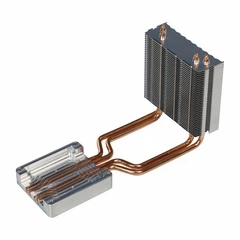
As a supplier of cavity water cooling plates, I've witnessed firsthand the growing demand for efficient heat dissipation solutions across various industries. In this blog, I'll delve into how cavity water cooling plates improve heat dissipation efficiency and why they are becoming the go - to choice for many applications.
The Basics of Heat Dissipation
Before we explore the advantages of cavity water cooling plates, it's essential to understand the principles of heat dissipation. Heat transfer occurs through three main mechanisms: conduction, convection, and radiation. Conduction is the transfer of heat through a solid material, convection involves the movement of a fluid (liquid or gas) to carry heat away, and radiation is the emission of heat in the form of electromagnetic waves.
In most electronic and mechanical systems, excessive heat can lead to performance degradation, reduced lifespan, and even system failure. Therefore, efficient heat dissipation is crucial to maintain optimal operation. Traditional heat sinks, which rely mainly on conduction and natural or forced convection, have limitations in high - power applications. This is where cavity water cooling plates come into play.
How Cavity Water Cooling Plates Work
Cavity water cooling plates are designed with internal cavities or channels through which water or a coolant fluid can flow. The basic working principle involves the absorption of heat from the heat - generating component (such as an electronic chip or a battery) through conduction. The heat is then transferred to the coolant flowing inside the cavities.
The coolant, usually water with additives to prevent corrosion and freezing, absorbs the heat and carries it away from the heat source. As the heated coolant circulates through the cooling system, it reaches a heat exchanger, where the heat is dissipated to the surrounding environment. This continuous cycle of heat absorption and dissipation helps to keep the temperature of the heat - generating component within a safe operating range.
Advantages of Cavity Water Cooling Plates in Improving Heat Dissipation Efficiency
High Thermal Conductivity
One of the key factors contributing to the high heat dissipation efficiency of cavity water cooling plates is the high thermal conductivity of water. Water has a relatively high specific heat capacity, which means it can absorb a large amount of heat with only a small increase in temperature. Compared to air, which is commonly used in traditional cooling systems, water can transfer heat much more effectively.
For example, in a high - power electronic device, a cavity water cooling plate can quickly conduct the heat from the device to the water inside the cavities. The water then transports the heat away, preventing the device from overheating. This is especially important in applications where the heat flux is very high, such as in data centers or electric vehicles.
Uniform Heat Distribution
Cavity water cooling plates can provide more uniform heat distribution across the surface of the heat - generating component. The internal channels in the plate are designed to ensure that the coolant flows evenly throughout the plate. This helps to eliminate hot spots, which are areas of high temperature that can cause damage to the component.
In an Automotive Controller Water Cooling Plate, for instance, the uniform heat distribution ensures that all parts of the automotive controller operate at a consistent temperature. This not only improves the performance of the controller but also extends its lifespan.
Compact Design
Another advantage of cavity water cooling plates is their compact design. Compared to large - scale air - cooling systems, water cooling plates can be made smaller and more lightweight. This is particularly beneficial in applications where space is limited, such as in portable electronic devices or automotive engines.
A Cavity - type Energy Storage Battery Water Cooling Plate can be integrated into the battery pack with minimal additional space requirements. This allows for more efficient use of space in energy storage systems, which is essential for the development of high - density battery technologies.
Scalability
Cavity water cooling plates are highly scalable. They can be designed and customized to meet the specific heat dissipation requirements of different applications. Whether it's a small - scale consumer electronic device or a large - scale industrial machine, the size, shape, and number of channels in the cooling plate can be adjusted accordingly.
In the case of an Automobile Car Drainage Raditor, the cooling plate can be optimized to handle the heat generated by the engine under different operating conditions. This scalability makes cavity water cooling plates a versatile solution for a wide range of industries.


Applications of Cavity Water Cooling Plates
Cavity water cooling plates have a wide range of applications in various industries.
Electronics Industry
In the electronics industry, cavity water cooling plates are used to cool high - power electronic components such as CPUs, GPUs, and power amplifiers. These components generate a significant amount of heat during operation, and efficient cooling is essential to maintain their performance and reliability.
Data centers, which house thousands of servers, also rely on cavity water cooling plates to manage the heat generated by the servers. By using water cooling systems, data centers can reduce their energy consumption and improve their overall efficiency.
Automotive Industry
The automotive industry is another major user of cavity water cooling plates. In electric vehicles, water cooling plates are used to cool the battery packs and power electronics. The high - power batteries in electric vehicles generate a large amount of heat during charging and discharging, and proper cooling is crucial to ensure the safety and performance of the battery.
In traditional internal combustion engines, water cooling plates are used in the engine cooling system to maintain the engine temperature within a safe range. This helps to improve the engine's efficiency and reduce emissions.
Energy Storage Industry
In the energy storage industry, cavity water cooling plates are used to cool energy storage batteries. As the demand for large - scale energy storage systems increases, the need for efficient heat dissipation solutions becomes more critical. Cavity water cooling plates can help to improve the performance and lifespan of energy storage batteries by maintaining a stable temperature.
Contact for Procurement
If you are interested in our cavity water cooling plates and would like to discuss your specific heat dissipation requirements, please feel free to contact us. We have a team of experts who can provide you with customized solutions and high - quality products. Whether you are in the electronics, automotive, or energy storage industry, we are confident that our cavity water cooling plates can meet your needs and help you improve the efficiency of your systems.
References
- Incropera, F. P., & DeWitt, D. P. (2001). Fundamentals of Heat and Mass Transfer. John Wiley & Sons.
- Bergman, T. L., Lavine, A. S., Incropera, F. P., & DeWitt, D. P. (2011). Introduction to Heat Transfer. John Wiley & Sons.
- Kakaç, S., & Pramuanjaroenkij, A. (2005). Heat Exchangers: Selection, Rating, and Thermal Design. CRC Press.