


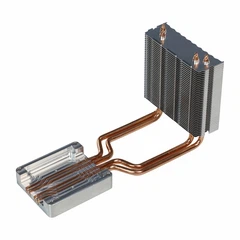
Yo, what's up everyone! I'm an aluminum finned heat sink supplier, and today I wanna chat about the shape of these bad boys. Aluminum finned heat sinks are super important in a whole bunch of industries, from electronics to machinery. They're all about getting rid of heat efficiently, and believe it or not, the shape plays a huge role in how well they work.
Let's start with the basics. The most common shape you'll see is the rectangular one. It's like the go - to for a lot of applications. Rectangular heat sinks are easy to manufacture and can fit into standard enclosures without any hassle. They usually have fins that run parallel to each other, which helps in creating a smooth airflow path. When air passes over these fins, it picks up the heat from the aluminum and carries it away.
For example, in a computer CPU cooler, a rectangular heat sink is often used. The CPU generates a ton of heat when it's running, and the rectangular heat sink with its parallel fins can quickly transfer that heat to the surrounding air. This keeps the CPU from overheating and ensures that your computer runs smoothly.
But it's not all about rectangles. There are also circular heat sinks. These are great for applications where space is limited and you need a more compact design. Circular heat sinks have fins arranged in a radial pattern, kind of like the spokes on a wheel. This design allows for a more even distribution of heat around the circumference.
Think about a high - end flashlight. The LED in a flashlight can get really hot. A circular aluminum finned heat sink can be used to cool the LED. The radial fins draw the heat away from the center (where the LED is) and spread it out evenly, so the flashlight doesn't overheat and the LED lasts longer.
Another interesting shape is the L - shaped heat sink. This is useful when you have a component that needs cooling but is placed in a corner or an area where a regular rectangular or circular heat sink won't fit. The L - shape allows it to be installed in those tight spaces.
In some industrial control panels, there are components that are located at the corner. An L - shaped heat sink can be used to cool these components effectively. It can be attached to the component in such a way that it maximizes the surface area for heat transfer, even in a restricted space.
Now, let's talk about some of the more specialized heat sinks we offer. We have the DCC Power Control High - Power Heatsink. This one has a unique shape that's designed specifically for high - power applications. It has large, thick fins that are optimized to handle a lot of heat. The shape is engineered to ensure that there's a good airflow through the fins, even when the power consumption is high.
Then there's the Air - Cooled Laser Module Heatsink. Lasers generate a ton of heat, and this heat sink is shaped to deal with that. It has a complex fin design that maximizes the surface area for heat transfer. The shape allows for efficient air cooling, which is crucial for maintaining the performance and lifespan of the laser module.
And we can't forget about the All Aluminum Stacked Radiator. This radiator has a stacked shape, which means it has multiple layers of fins. This design increases the overall surface area for heat transfer significantly. It's great for applications where you need to cool a large amount of heat in a relatively small space.


The shape of an aluminum finned heat sink also affects its manufacturing process. Different shapes require different techniques. For example, rectangular heat sinks can be easily extruded. Extrusion is a process where aluminum is forced through a die to create a specific shape. It's a cost - effective way to produce heat sinks in large quantities.
Circular heat sinks, on the other hand, might require more complex machining processes. They could be machined from a solid block of aluminum or formed using a combination of casting and machining. This makes them a bit more expensive to produce, but they're worth it for applications where their unique shape is necessary.
When it comes to choosing the right shape of an aluminum finned heat sink for your application, there are a few factors to consider. First, you need to think about the available space. If you have a small enclosure, a circular or L - shaped heat sink might be a better option. If space isn't an issue, a rectangular heat sink could work just fine.
You also need to consider the amount of heat that needs to be dissipated. High - power applications will require heat sinks with larger surface areas and more efficient shapes. The airflow in the environment is another important factor. If the airflow is restricted, you'll need a heat sink shape that can still work effectively with limited air movement.
We, as a supplier, have a team of experts who can help you choose the right shape of heat sink for your specific needs. Whether you're working on a small electronics project or a large industrial application, we've got you covered.
If you're in the market for an aluminum finned heat sink, don't hesitate to reach out. We can provide you with detailed information about our products, including their shapes, performance, and pricing. We're always happy to have a chat and see how we can help you with your heat dissipation needs. So, let's start a conversation about getting the perfect heat sink for your project!
References
- "Heat Transfer in Electronic Equipment" by some experts in the field
- Industry reports on aluminum heat sink manufacturing and applications