


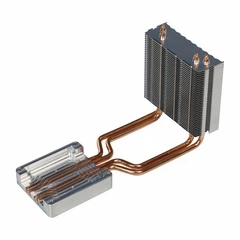
As a supplier of Heat Pipe Aluminum Heat Sinks, I've been in the trenches of the heat dissipation game for quite some time. One question that pops up a lot when chatting with clients or industry folks is, "What's the deal with the heat sink's fin density in heat dissipation?" Well, let's dive right in and break it down.
The Basics of Heat Sinks and Fins
First off, a heat sink is a device that transfers heat from a hot component, like a CPU or a power transistor, to the surrounding environment. It does this mainly through convection and radiation. The fins on a heat sink play a crucial role in this process. They increase the surface area of the heat sink, allowing more heat to be transferred to the air.
Think of it this way: if you're trying to dry a wet towel, you'd spread it out to expose more of its surface to the air. The more surface area, the faster it dries. Heat sinks work on the same principle. The fins are like little fingers reaching out into the air, grabbing the heat and letting it escape.
Fin Density and Heat Dissipation
Now, let's talk about fin density. Fin density refers to the number of fins per unit length on the heat sink. It can have a significant impact on how well the heat sink dissipates heat.
When the fin density is high, there are more fins packed into a given space. This means more surface area for heat transfer, which is a good thing. With more surface area, more heat can be absorbed from the heat source and transferred to the air. In theory, a heat sink with a high fin density should be better at dissipating heat than one with a low fin density.
But here's the catch: high fin density also comes with some drawbacks. The spaces between the fins, called fin channels, become narrower as the fin density increases. This can cause problems with air flow. When air has to squeeze through tiny channels, it experiences more resistance. This reduces the amount of air that can flow through the heat sink, which in turn reduces the amount of heat that can be carried away.
On the other hand, a heat sink with a low fin density has wider fin channels. This allows air to flow more freely through the heat sink, which is great for convection. However, because there are fewer fins, the total surface area available for heat transfer is lower. So, while the air flow is better, there's less surface area to absorb and transfer heat.
Finding the Sweet Spot
So, what's the perfect fin density? Well, there's no one-size-fits-all answer. It depends on a variety of factors, including the type of application, the available air flow, and the power of the heat source.
For applications where there's a lot of air flow, like in a computer with a high-powered fan, a higher fin density might be a good choice. The strong air flow can overcome the resistance in the narrow fin channels and still carry away a large amount of heat. In these cases, the increased surface area provided by the high fin density can really make a difference.
On the other hand, if the air flow is limited, like in a small, enclosed space, a lower fin density might be better. The wider fin channels allow the limited air to flow more easily through the heat sink, ensuring that at least some heat can be dissipated.
As a Heat Pipe Aluminum Heat Sink supplier, we've spent a lot of time testing different fin densities to find the best balance for our clients. We offer a range of heat sinks with different fin densities to meet the needs of various applications.
Real-World Examples
Let's look at some real-world examples to see how fin density affects heat dissipation.
Imagine you're working on a communication module. This type of application usually generates a moderate amount of heat and has limited space for a heat sink. In this case, an Aluminum Heat Pipe Communication Module Heatsink with a medium fin density might be the best choice. The heat pipe helps to transfer heat efficiently from the heat source to the fins, and the medium fin density provides enough surface area for heat transfer without causing too much air flow resistance.
Now, consider an automotive controller. These devices often operate in harsh environments with high temperatures and limited air flow. A Lightweight Automotive Controller Water Cooling Plate might be a better option here. The water cooling system can provide efficient heat dissipation, and the low fin density on the cooling plate allows for better air flow in the limited space.
Another example is a cavity-type energy storage battery. These batteries generate a significant amount of heat during charging and discharging. A Cavity-type Energy Storage Battery Water Cooling Plate with a high fin density can be used to maximize the surface area for heat transfer. The water cooling system helps to carry away the heat effectively, and the high fin density ensures that as much heat as possible is transferred from the battery to the cooling plate.
The Role of Other Factors
It's important to note that fin density is just one factor in heat dissipation. Other factors, such as the material of the heat sink, the design of the fins, and the type of fluid (air or liquid) used for cooling, also play important roles.


For example, aluminum is a popular material for heat sinks because it's lightweight and has good thermal conductivity. The design of the fins, such as their shape and size, can also affect how well they transfer heat. And if you're using a liquid cooling system, the flow rate and temperature of the liquid can have a big impact on heat dissipation.
Conclusion and Call to Action
In conclusion, the fin density of a heat sink plays a crucial role in heat dissipation. It's a balancing act between maximizing surface area for heat transfer and ensuring good air flow. As a Heat Pipe Aluminum Heat Sink supplier, we understand the importance of finding the right fin density for each application.
If you're in the market for a heat sink or need advice on heat dissipation solutions, we're here to help. We have a team of experts who can work with you to understand your specific needs and recommend the best heat sink or cooling system for your application. Contact us today to start a conversation and see how we can help you solve your heat dissipation problems.
References
- Incropera, F. P., & DeWitt, D. P. (2013). Fundamentals of Heat and Mass Transfer. Wiley.
- Kays, W. M., & Crawford, M. E. (2005). Convective Heat and Mass Transfer. McGraw-Hill.