


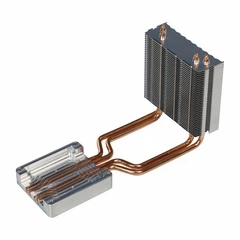
As a reputable supplier of Heat Pipe Aluminum Heat Sinks, I've witnessed firsthand the remarkable capabilities and significance of heat pipes within these cooling solutions. Heat pipe aluminum heat sinks are widely employed in various industries, from electronics to automotive, to dissipate heat effectively and maintain optimal operating temperatures. In this blog, I'll delve into the crucial role of the heat pipe in a heat pipe aluminum heat sink, exploring its principles, advantages, and real - world applications.
Principles of Heat Pipes
Heat pipes are highly efficient heat transfer devices that operate on the principles of phase change and capillary action. A typical heat pipe consists of a sealed tube, usually made of copper or aluminum, which is evacuated and then partially filled with a working fluid such as water, methanol, or ammonia. The inner surface of the tube is lined with a wick structure, which can be made of sintered powder, grooves, or fibers.
The operation of a heat pipe can be divided into three main stages: evaporation, transport, and condensation. When heat is applied to one end of the heat pipe (the evaporator section), the working fluid inside the wick absorbs the heat and evaporates. This phase change from liquid to vapor absorbs a large amount of latent heat, which effectively removes heat from the heat source. The vapor then moves along the heat pipe towards the cooler end (the condenser section) due to the pressure difference created by the temperature gradient.
Once the vapor reaches the condenser section, it releases the latent heat as it condenses back into a liquid. The condensed liquid is then drawn back to the evaporator section by the capillary action of the wick structure. This continuous cycle of evaporation, transport, and condensation allows the heat pipe to transfer heat rapidly and efficiently over long distances with minimal temperature difference.
Role of Heat Pipes in Heat Pipe Aluminum Heat Sinks
Enhanced Heat Transfer Efficiency
One of the primary roles of the heat pipe in a heat pipe aluminum heat sink is to enhance the heat transfer efficiency. Aluminum is a good conductor of heat, but heat pipes can significantly improve the overall thermal performance of the heat sink. By using heat pipes to transfer heat from the heat source to the fins of the heat sink, the heat can be distributed more evenly across the surface area of the fins. This increases the effective heat transfer area and allows for more efficient heat dissipation.
For example, in a traditional aluminum heat sink, the heat spreads slowly through the solid material, resulting in a large temperature gradient between the heat source and the outer edges of the heat sink. In contrast, a heat pipe aluminum heat sink can quickly transfer the heat from the heat source to the fins, reducing the temperature gradient and improving the overall cooling efficiency.
Isothermalization
Heat pipes also play a crucial role in isothermalization, which is the process of equalizing the temperature across the surface of the heat sink. In many applications, such as high - power electronics, it is essential to maintain a uniform temperature distribution to prevent hot spots and ensure the reliable operation of the components.
Heat pipes can effectively transfer heat from hot areas to cooler areas, thereby reducing the temperature differences within the heat sink. This isothermal effect helps to improve the performance and lifespan of the electronic components by preventing overheating and thermal stress.
Flexibility in Design
Another advantage of using heat pipes in heat pipe aluminum heat sinks is the flexibility in design. Heat pipes can be bent, shaped, and routed in various ways to fit different application requirements. This allows for the creation of compact and efficient heat sink designs that can be customized to specific heat source geometries and installation spaces.


For instance, in some electronic devices with limited space, heat pipes can be used to transfer heat from a high - power component to a remote heat sink located in a more accessible area. This flexibility in design enables the development of innovative cooling solutions for a wide range of applications.
Real - World Applications
Electronics Cooling
In the electronics industry, heat pipe aluminum heat sinks are widely used to cool high - power components such as CPUs, GPUs, and power transistors. These components generate a significant amount of heat during operation, and effective cooling is essential to prevent performance degradation and premature failure.
Heat pipe aluminum heat sinks can provide efficient cooling solutions for these components by quickly transferring the heat away from the heat source and dissipating it into the surrounding environment. For example, in a desktop computer, a heat pipe aluminum heat sink is often used to cool the CPU. The heat pipe transfers the heat from the CPU to the fins of the heat sink, which are then cooled by a fan. This ensures that the CPU operates at a safe temperature and maintains optimal performance.
Automotive Industry
The automotive industry also benefits from the use of heat pipe aluminum heat sinks. In modern vehicles, there are many electronic components and power systems that generate heat, such as Automobile Car Drainage Raditor, Lightweight Automotive Controller Water Cooling Plate, and Automotive Controller Water Cooling Plate. Heat pipe aluminum heat sinks can be used to cool these components and ensure their reliable operation.
For example, in electric vehicles, the battery management system and power electronics generate a significant amount of heat. Heat pipe aluminum heat sinks can be used to dissipate this heat and maintain the optimal temperature of the components, which is crucial for the performance and safety of the vehicle.
Conclusion
In conclusion, the heat pipe plays a vital role in a heat pipe aluminum heat sink. Its ability to enhance heat transfer efficiency, achieve isothermalization, and provide flexibility in design makes it an essential component in many cooling applications. Whether in the electronics industry or the automotive industry, heat pipe aluminum heat sinks offer reliable and efficient cooling solutions for high - power components.
If you are in need of high - quality heat pipe aluminum heat sinks for your application, we are here to assist you. Our team of experts can work with you to design and manufacture customized heat sink solutions that meet your specific requirements. Contact us today to start a procurement discussion and find the best cooling solution for your needs.
References
- Incropera, F. P., & DeWitt, D. P. (2002). Fundamentals of Heat and Mass Transfer. Wiley.
- Kakaç, S., & Pramuanjaroenkij, A. (2005). Heat Pipes: Theory, Design, and Applications. Butterworth - Heinemann.
- Kraus, A. D., Azar, M. N., & Bar - Cohen, A. (2001). Thermal Design of Electronic Equipment. Wiley - Interscience.