


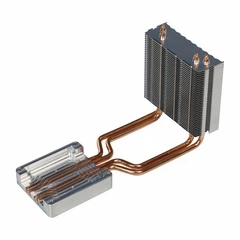
In the automotive industry, the efficient operation of car controllers is crucial for the overall performance and safety of vehicles. Car controller heatsinks play a vital role in maintaining the optimal temperature of these controllers, preventing overheating and ensuring their reliability. There are two main types of car controller heatsinks: active and passive. As a professional car controller heatsink supplier, I will delve into the differences between these two types to help you make informed decisions for your automotive applications.
Active Car Controller Heatsinks
Active car controller heatsinks are designed to actively remove heat from the car controller using external power sources. These heatsinks typically incorporate fans, pumps, or other mechanical devices to enhance the heat transfer process.
Working Principle
The basic working principle of an active heatsink involves the use of a fan or a pump to force air or coolant over the heatsink surface. This forced convection significantly increases the heat transfer rate compared to natural convection, which is the primary mechanism in passive heatsinks. For example, in a liquid - cooled active heatsink, a pump circulates coolant through channels in the heatsink. The coolant absorbs heat from the car controller and then transfers it to a radiator, where it is dissipated into the surrounding environment.
Advantages
- High Heat Dissipation Capacity: Active heatsinks are capable of removing a large amount of heat in a relatively short period. This makes them ideal for high - power car controllers that generate a significant amount of heat during operation. For instance, modern electric vehicle controllers, which handle high - voltage and high - current circuits, often require active heatsinks to maintain their temperature within safe limits.
- Flexibility: They can be adjusted according to the actual heat load. The speed of the fan or the flow rate of the coolant can be regulated based on the temperature of the car controller. This allows for more precise temperature control and energy efficiency.
Disadvantages
- Power Consumption: Active heatsinks require an external power source to operate. This not only adds to the overall power consumption of the vehicle but also requires additional wiring and control systems.
- Complexity and Cost: The addition of mechanical components such as fans and pumps increases the complexity of the heatsink design. This leads to higher manufacturing costs and a greater risk of mechanical failure. Maintenance and repair of active heatsinks can also be more challenging and expensive.
Passive Car Controller Heatsinks
Passive car controller heatsinks rely on natural convection and radiation to dissipate heat. They do not require any external power source and consist mainly of a thermally conductive material, such as aluminum or copper.
Working Principle
Passive heatsinks work by providing a large surface area for heat transfer. The heat generated by the car controller is conducted through the heatsink material and then dissipated into the surrounding air through natural convection. The shape and design of the heatsink, such as fins or pins, are optimized to increase the surface area and enhance the heat transfer efficiency.
Advantages
- Low Power Consumption: Since they do not require an external power source, passive heatsinks have zero power consumption. This is beneficial for vehicles where power efficiency is a priority, such as hybrid and electric vehicles.
- Simplicity and Reliability: Passive heatsinks have a simple design with no moving parts. This makes them more reliable and less prone to mechanical failure. They also require less maintenance compared to active heatsinks.
- Cost - Effective: The manufacturing process of passive heatsinks is relatively simple, resulting in lower production costs. This makes them a more affordable option for many automotive applications.
Disadvantages
- Limited Heat Dissipation Capacity: Passive heatsinks are less effective at dissipating large amounts of heat compared to active heatsinks. They are suitable for low - power car controllers or applications where the heat generation is relatively low.
- Dependence on Environmental Conditions: The performance of passive heatsinks is highly dependent on the surrounding environment. Factors such as air temperature, humidity, and airflow can significantly affect their heat dissipation efficiency.
Applications
The choice between active and passive car controller heatsinks depends on the specific requirements of the automotive application.
Active Heatsinks
- High - Performance Vehicles: In high - performance sports cars or electric vehicles with high - power drivetrains, active heatsinks are often used to cool the car controllers. These controllers need to handle large amounts of electrical power, and active cooling is necessary to prevent overheating.
- Advanced Driver - Assistance Systems (ADAS): ADAS controllers are becoming increasingly complex and powerful. They require efficient cooling solutions to ensure reliable operation, especially in demanding driving conditions. Active heatsinks can provide the necessary heat dissipation for these systems.
Passive Heatsinks
- Entry - Level Vehicles: In entry - level cars or vehicles with less complex electrical systems, passive heatsinks are commonly used. They offer a cost - effective solution for cooling the car controllers while still maintaining acceptable performance.
- Auxiliary Controllers: Passive heatsinks are also suitable for auxiliary car controllers, such as those used for interior lighting, climate control, or power window systems. These controllers typically generate less heat and can be effectively cooled by passive means.
Our Product Offerings
As a car controller heatsink supplier, we offer a wide range of both active and passive heatsinks to meet the diverse needs of the automotive industry. Our Lightweight Automotive Controller Water Cooling Plate is an excellent example of an active heatsink. It is designed with a lightweight structure and high - efficiency cooling channels to provide superior heat dissipation for high - power car controllers.


Our Automotive Controller Water Cooling Plate is another high - quality product that combines advanced cooling technology with a compact design. It is suitable for a variety of automotive applications, from electric vehicles to traditional internal combustion engine cars.
For applications where cost - effectiveness and simplicity are key, our Cavity - type Energy Storage Battery Water Cooling Plate offers a passive cooling solution. It provides reliable heat dissipation for energy storage battery controllers and other low - power car controllers.
Conclusion
In summary, the main differences between active and passive car controller heatsinks lie in their heat dissipation mechanisms, performance, and cost. Active heatsinks offer high heat dissipation capacity and flexibility but come with the drawbacks of power consumption and complexity. Passive heatsinks, on the other hand, are more cost - effective, reliable, and power - efficient but have limited heat dissipation capabilities.
When choosing a car controller heatsink, it is essential to consider factors such as the power of the car controller, the operating environment, and the budget. As a trusted car controller heatsink supplier, we are committed to providing high - quality products and professional technical support. If you are interested in our products or need more information about car controller heatsinks, please feel free to contact us for procurement and negotiation.
References
- Incropera, F. P., DeWitt, D. P., Bergman, T. L., & Lavine, A. S. (2007). Fundamentals of Heat and Mass Transfer. Wiley.
- Tummala, R. R., & Rymaszewski, E. J. (1989). Microelectronics Packaging Handbook. Van Nostrand Reinhold.