


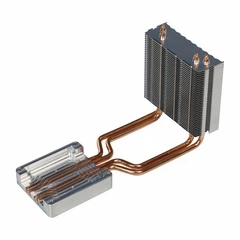
Yo, what's up? I'm an all aluminum stacked radiator supplier, and today I wanna dive into the topic of what the heat transfer coefficient of an all aluminum stacked radiator is. Let's get right into it!
First off, you might be wondering what the heat transfer coefficient actually means. Well, in simple terms, it's a measure of how well a material can transfer heat. For our all aluminum stacked radiators, this coefficient is super important because it directly impacts how effectively the radiator can cool down whatever it's attached to.
Aluminum is a great material for radiators because it has some pretty awesome thermal properties. It's got a relatively high thermal conductivity, which means it can transfer heat from one point to another quickly. This is crucial for a radiator, as its main job is to take the heat from the source (like an engine or an electronic device) and dissipate it into the surrounding environment.
The heat transfer coefficient of an all aluminum stacked radiator depends on a bunch of factors. One of the biggest ones is the design of the radiator itself. A well - designed stacked radiator will have a large surface area. You see, the more surface area the radiator has, the more contact it has with the air (or the cooling fluid, if it's a liquid - cooled radiator), and the better it can transfer heat. Our stacked radiators are engineered to maximize this surface area through the use of fin structures. These fins act like tiny heat - transfer bridges, increasing the area available for heat exchange.
Another factor that affects the heat transfer coefficient is the flow rate of the coolant. Whether it's air flowing over the radiator fins or a liquid coolant circulating through the channels, a higher flow rate generally leads to a higher heat transfer coefficient. That's because a faster - moving coolant can carry away the heat more quickly, keeping the temperature of the radiator lower and allowing for more efficient heat transfer.
The thickness and quality of the aluminum used also play a role. Thinner aluminum can transfer heat more quickly because there's less material for the heat to pass through. However, it also needs to be strong enough to withstand the pressure and vibrations in the application. We use high - quality aluminum in our radiators, which has been carefully selected to balance thermal performance and durability.
Now, let's talk about some real - world applications. All aluminum stacked radiators are used in a wide range of industries. In the automotive world, they're used to cool engines. A high heat transfer coefficient means that the engine can run at a lower temperature, which improves its performance and extends its lifespan. In the electronics industry, our radiators are used to cool things like power supplies and computer processors. Overheating can cause these components to malfunction or even fail, so having an efficient radiator is crucial.
If you're interested in other types of aluminum radiators, we also offer some great options. Check out our Air - Cooled Laser Module Heatsink. It's specifically designed to cool laser modules, which generate a lot of heat. The design of this heatsink is optimized to achieve a high heat transfer coefficient, ensuring that the laser module stays at a stable temperature.
Our Aluminum Finned Heat Sink is another popular choice. The fins on this heat sink are designed to increase the surface area, which in turn boosts the heat transfer coefficient. It's a versatile option that can be used in many different applications, from small electronic devices to industrial equipment.
And for those of you who need a more advanced cooling solution, we have the Combination Water Cooling Radiator. This radiator combines the benefits of water cooling and air cooling, which can result in an even higher heat transfer coefficient compared to traditional air - cooled radiators.
Calculating the exact heat transfer coefficient of an all aluminum stacked radiator can be a bit tricky. It usually involves some complex equations that take into account all the factors I mentioned earlier, like the surface area, coolant flow rate, and material properties. But generally, our radiators have a very competitive heat transfer coefficient compared to other products on the market.


So, if you're in the market for an all aluminum stacked radiator or any of our other radiator products, feel free to reach out to us. Whether you're an automotive manufacturer looking to cool your engines more efficiently or an electronics company trying to keep your components from overheating, we've got the solution for you. Our team of experts is always ready to help you find the right radiator for your specific needs.
In conclusion, the heat transfer coefficient of an all aluminum stacked radiator is a key factor in its performance. By understanding the factors that affect this coefficient and choosing a high - quality radiator like ours, you can ensure efficient heat transfer and reliable cooling for your application. Come and talk to us to see how we can help you with your cooling requirements.
References
- Incropera, F. P., & DeWitt, D. P. (2002). Fundamentals of Heat and Mass Transfer. John Wiley & Sons.
- Kays, W. M., Crawford, M. E., & Weigand, B. (2005). Convective Heat and Mass Transfer (4th ed.). McGraw - Hill.