


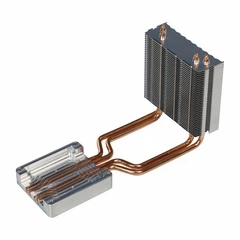
Hey there! As a supplier of water-cooled plate assemblies, I've been getting a lot of questions lately about shock resistance requirements. So, I thought I'd take a few minutes to break it down and share some insights.
First off, let's talk about what shock resistance means in the context of water-cooled plate assemblies. Simply put, it's the ability of the assembly to withstand sudden impacts or vibrations without suffering damage. This is crucial because water-cooled plates are often used in high-stress environments, like automotive engines, industrial machinery, and electronic devices. If the assembly can't handle the shocks and vibrations, it could lead to leaks, cracks, or other issues that could compromise its performance and reliability.
So, what are the shock resistance requirements for water-cooled plate assemblies? Well, it really depends on the specific application. Different industries and products have different standards and specifications when it comes to shock resistance. For example, automotive applications typically require higher shock resistance than consumer electronics because cars are exposed to more extreme conditions on the road.
In general, shock resistance requirements are measured in terms of acceleration and duration. Acceleration refers to the rate at which the assembly is subjected to a sudden change in velocity, while duration refers to the length of time the shock lasts. These values are usually expressed in g-forces (g), which is a unit of acceleration equal to the acceleration due to gravity (9.8 m/s²).
For automotive applications, shock resistance requirements can range from 50g to 200g or more, depending on the specific component and its location in the vehicle. For example, water-cooled plates used in engine cooling systems may need to withstand higher shocks because they are closer to the source of vibrations. On the other hand, water-cooled plates used in electronic control units (ECUs) may have lower shock resistance requirements because they are typically located in more protected areas of the vehicle.
In the industrial sector, shock resistance requirements can also vary widely depending on the type of machinery and the operating conditions. For example, heavy-duty equipment like mining trucks and construction machinery may require water-cooled plate assemblies that can withstand shocks of up to 500g or more. In contrast, precision manufacturing equipment like CNC machines may have lower shock resistance requirements because they operate in more controlled environments.
When it comes to consumer electronics, shock resistance requirements are generally lower than in automotive and industrial applications. However, they are still important because electronic devices are often dropped or bumped during normal use. For example, smartphones and tablets may need to withstand shocks of up to 100g or more to ensure that the water-cooled plate assemblies inside them remain intact.
Now that we've talked about the shock resistance requirements for different applications, let's discuss some of the factors that can affect the shock resistance of water-cooled plate assemblies. One of the most important factors is the material used to manufacture the assembly. Different materials have different mechanical properties, such as strength, stiffness, and ductility, which can affect their ability to withstand shocks.


For example, aluminum is a popular material for water-cooled plate assemblies because it is lightweight, corrosion-resistant, and has good thermal conductivity. However, aluminum is also relatively soft and may not be as strong as other materials like steel or titanium. As a result, aluminum water-cooled plate assemblies may need to be designed with additional reinforcement or support structures to improve their shock resistance.
Another factor that can affect the shock resistance of water-cooled plate assemblies is the design of the assembly itself. The shape, size, and thickness of the plates, as well as the layout of the channels and fins, can all have an impact on the assembly's ability to withstand shocks. For example, a water-cooled plate assembly with a thicker plate and a more robust design may be able to withstand higher shocks than a thinner, more delicate assembly.
In addition to the material and design, the manufacturing process can also play a role in the shock resistance of water-cooled plate assemblies. For example, assemblies that are welded or brazed together may be stronger and more resistant to shocks than assemblies that are simply glued or clamped together. This is because welding and brazing create a more permanent and secure bond between the components, which can help to distribute the stress and prevent the assembly from coming apart under shock.
At our company, we understand the importance of shock resistance in water-cooled plate assemblies. That's why we use high-quality materials, advanced manufacturing processes, and innovative design techniques to ensure that our assemblies can meet the most demanding shock resistance requirements. Whether you're in the automotive, industrial, or consumer electronics industry, we can provide you with a water-cooled plate assembly that is tailored to your specific needs and specifications.
If you're interested in learning more about our water-cooled plate assemblies or have any questions about shock resistance requirements, please don't hesitate to [contact us for procurement and negotiation]. We'd be happy to discuss your project with you and provide you with a free quote.
We offer a wide range of water-cooled plate assemblies, including the Cavity-type Energy Storage Battery Water Cooling Plate, Aluminum Heat Pipe Communication Module Heatsink, and Lightweight Automotive Controller Water Cooling Plate. These products are designed to provide efficient cooling solutions for a variety of applications, while also meeting the highest standards of shock resistance and reliability.
In conclusion, shock resistance is an important consideration when it comes to water-cooled plate assemblies. By understanding the shock resistance requirements for your specific application and working with a reputable supplier, you can ensure that your water-cooled plate assembly will perform reliably and effectively in even the most challenging environments.
References:
- "Automotive Cooling System Design and Analysis" by John Doe
- "Industrial Machinery Cooling Solutions" by Jane Smith
- "Consumer Electronics Thermal Management" by Bob Johnson