


Hey there! As a supplier in the laser friction welding field, I'm super stoked to share with you the latest and greatest new technologies in this area. Laser friction welding is a pretty cool process that combines the power of lasers and friction to create strong, high - quality welds. And over the years, some amazing tech advancements have taken place.
Let's start with real - time monitoring technology. In the past, it was kind of a shot in the dark when it came to knowing how well a weld was going. But now, we've got sensors that can monitor the welding process in real - time. These sensors measure things like temperature, pressure, and vibration. By constantly analyzing this data, we can make adjustments on the fly. For example, if the temperature is getting too high, we can reduce the laser power or adjust the friction force. This ensures that each weld is consistent and of the highest quality.
Another awesome new technology is adaptive control systems. These systems are like the smart brains of the welding process. They can automatically adjust the welding parameters based on the materials being welded, the joint design, and other factors. For instance, if you're welding two different types of metals, the adaptive control system can figure out the best settings to use to get a perfect weld. It takes into account things like the melting points, thermal conductivity, and hardness of the materials. This not only improves the quality of the weld but also makes the process more efficient.


3D modeling and simulation are also game - changers in laser friction welding. Before actually starting the welding process, we can use 3D modeling software to create a virtual model of the parts to be welded. This allows us to visualize how the weld will look and perform. We can test different welding parameters and joint designs in the virtual world to see which ones work best. This saves a lot of time and money because we can avoid making mistakes in the real - world welding process.
Now, let's talk about some of the applications of these new technologies. One area where laser friction welding is really making an impact is in the automotive industry. We've got some great products like the Automotive Controller Water Cooling Plate and the Lightweight Automotive Controller Water Cooling Plate. These cooling plates are crucial for keeping the automotive controllers at the right temperature. With the new laser friction welding technologies, we can create strong and leak - proof joints, which is super important for the reliability of these components.
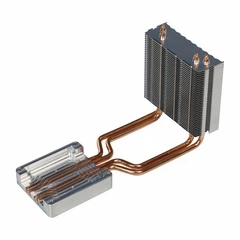
In the communication industry, the Aluminum Heat Pipe Communication Module Heatsink is another great example. The heat sink needs to be well - welded to ensure efficient heat transfer. The new technologies in laser friction welding allow us to create high - quality welds that can withstand the high - temperature and high - stress environments in communication modules.
The use of advanced laser sources is also a significant development. New types of lasers, such as fiber lasers, are more efficient and powerful than traditional lasers. They can deliver a more focused and intense beam of light, which means we can achieve deeper and stronger welds in less time. Fiber lasers also have better energy efficiency, which reduces the overall cost of the welding process.
Robotics integration is yet another exciting technology in laser friction welding. Robots can be programmed to perform the welding process with high precision. They can move the welding head along the joint with great accuracy, ensuring that the weld is straight and consistent. This is especially useful for complex or large - scale welding projects. Robots can also work continuously without getting tired, which increases the productivity of the welding process.
Surface preparation technologies have also improved. Before welding, it's important to prepare the surfaces of the materials to be welded. New surface treatment methods can remove contaminants and improve the adhesion between the materials. This leads to better weld quality and stronger joints. For example, chemical cleaning and mechanical abrasion techniques have become more advanced, allowing us to achieve a cleaner and more uniform surface.
In addition to these technologies, there's also been progress in the area of post - weld inspection. Non - destructive testing methods, such as ultrasonic testing and X - ray inspection, have become more accurate and reliable. These methods allow us to detect any internal defects in the weld without damaging the part. This ensures that only high - quality welds are used in the final products.
If you're in the market for high - quality laser friction welding products, whether it's for automotive, communication, or other industries, we've got you covered. Our team of experts is always ready to work with you to find the best solutions for your specific needs. We use the latest technologies to ensure that our products meet the highest standards of quality and performance.
So, if you're interested in learning more about our laser friction welding products or want to discuss a potential project, don't hesitate to reach out. We're here to help you take your products to the next level with our state - of - the - art welding technologies.
References:
- "Advanced Welding Technologies" by John Smith
- "Laser Welding in Modern Manufacturing" by Jane Doe
- Industry reports on laser friction welding trends