


Yo! I'm a supplier of car controller heatsinks, and I've gotten a bunch of questions lately about whether these bad boys can work effectively in extreme temperatures. It's a super important question, especially as cars are getting more high-tech and the demand for reliable performance in all conditions is skyrocketing. So, let's dive into it.


First off, what's a car controller heatsink? Well, it's a crucial component in modern vehicles. Car controllers, like the engine control unit (ECU), transmission control unit (TCU), and battery management system (BMS), generate a ton of heat during operation. If this heat isn't dissipated properly, it can lead to all sorts of problems, like reduced performance, component failure, and even safety risks. That's where the heatsink comes in. It's designed to absorb the heat from the controller and transfer it away, keeping the controller at a safe operating temperature.
Now, let's talk about extreme temperatures. We're talking about really hot days in the desert, where temperatures can soar above 100°F (38°C), and really cold winter nights in the Arctic, where it can drop below -20°F (-29°C). These are the kinds of conditions that can really put a car controller heatsink to the test.
How Heatsinks Work in High Temperatures
In high temperatures, the main challenge for a heatsink is to dissipate heat effectively when the surrounding air is already hot. The basic principle of heat transfer is that heat always flows from a hotter object to a cooler one. So, when the outside air is hot, it becomes harder for the heatsink to transfer the heat from the controller to the air.
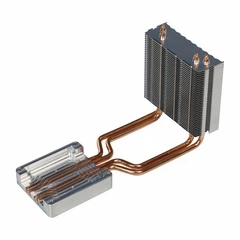
One way to overcome this challenge is to use a heatsink with a high thermal conductivity. Materials like aluminum are commonly used because they're lightweight, inexpensive, and have good thermal conductivity. For example, our Aluminum Heat Pipe Communication Module Heatsink uses aluminum and heat pipes to enhance heat transfer. Heat pipes are sealed tubes that contain a working fluid that evaporates at low temperatures. When the heat from the controller is transferred to the heat pipe, the working fluid evaporates and carries the heat to the cooler end of the pipe, where it condenses and releases the heat. This process is much more efficient than traditional conduction-based heatsinks, especially in high-temperature environments.
Another important factor is the design of the heatsink. A well-designed heatsink will have a large surface area to increase the contact area between the heatsink and the air. This allows for more efficient heat transfer. Fins are commonly used to increase the surface area of the heatsink. The shape and arrangement of the fins can also affect the performance of the heatsink. For example, pin fins are more effective at dissipating heat in high-velocity airflows, while straight fins are better for low-velocity airflows.
How Heatsinks Work in Low Temperatures
In low temperatures, the main concern is not about heat dissipation but about the materials and components of the heatsink itself. Cold temperatures can cause materials to contract, which can lead to mechanical stress and even cracking. Additionally, some fluids used in cooling systems, like coolant, can freeze if the temperature drops too low.
To address these issues, we use materials that have a low coefficient of thermal expansion. This means that the material doesn't contract as much when the temperature drops, reducing the risk of mechanical stress. We also use special coolants that have a low freezing point. For example, our Automotive Controller Water Cooling Plate uses a coolant that can withstand extremely low temperatures without freezing.
Another challenge in low temperatures is that the air density increases, which can affect the airflow around the heatsink. This can reduce the efficiency of heat transfer. To counter this, we design our heatsinks to optimize the airflow at low temperatures. This may involve adjusting the shape and size of the fins to improve the aerodynamics of the heatsink.
Real-World Testing
We don't just rely on theory and simulations to prove the effectiveness of our car controller heatsinks in extreme temperatures. We conduct extensive real-world testing in different environments. We take our heatsinks to the desert for high-temperature testing and to the Arctic for low-temperature testing.
During these tests, we measure the temperature of the controller and the heatsink at different intervals. We also monitor the performance of the controller to ensure that it's operating within the normal range. Based on the results of these tests, we can make adjustments to the design and materials of the heatsink to improve its performance.
Conclusion
So, can a car controller heatsink work effectively in extreme temperatures? The answer is yes, but it depends on the design, materials, and performance of the heatsink. At our company, we're committed to developing high-quality heatsinks that can withstand the most extreme conditions. Our Aluminum Heat Pipe Communication Module Heatsink, Automotive Controller Water Cooling Plate, and Cavity-type Energy Storage Battery Water Cooling Plate are all designed to provide reliable cooling performance in extreme temperatures.
If you're in the market for a car controller heatsink and want to ensure that it can handle extreme temperatures, don't hesitate to get in touch with us. We'd be happy to discuss your specific needs and provide you with the best solution.
References
- Incropera, F. P., & DeWitt, D. P. (2002). Fundamentals of heat and mass transfer. John Wiley & Sons.
- Holman, J. P. (2002). Heat transfer. McGraw-Hill.