


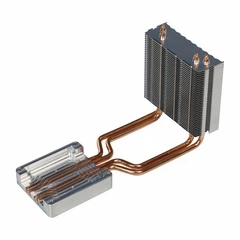
Hey there! As a supplier of water-cooled plate assemblies, I've been getting a lot of questions lately about the compatibility requirements for these bad boys. So, I thought I'd sit down and write a little something to clear things up.
First off, let's talk about what water-cooled plate assemblies are and why they're so important. These assemblies are basically a key component in many cooling systems. They work by transferring heat from a hot component, like a computer processor or a battery, to the water flowing through the plate. This helps to keep the component at a safe operating temperature, which is crucial for its performance and longevity.
Now, when it comes to compatibility, there are a few key factors that you need to consider.
1. Material Compatibility
The materials used in the water-cooled plate assembly need to be compatible with the coolant that will be flowing through it. Most commonly, water is used as a coolant, but sometimes additives are added to improve its heat transfer properties or to prevent corrosion.
If you're using a water-based coolant, you need to make sure that the materials in the plate won't corrode or react with the water. For example, aluminum is a popular choice for water-cooled plates because it's lightweight, has good thermal conductivity, and is relatively resistant to corrosion. However, if the coolant has a high pH or contains certain chemicals, it could cause the aluminum to corrode over time.
On the other hand, copper is another material with excellent thermal conductivity, but it can react with some coolants and form copper ions, which can be harmful to other components in the system. So, it's important to choose the right material based on the type of coolant you'll be using.
2. Size and Shape Compatibility
The size and shape of the water-cooled plate assembly need to match the component that it's going to be cooling. For example, if you're cooling a small electronic component, you'll need a small, compact water-cooled plate that can fit in the limited space available.
Similarly, the shape of the plate needs to be designed to make good contact with the component. A flat plate is suitable for cooling flat surfaces, but if the component has a complex shape, you might need a custom-designed plate that can conform to its contours. This ensures that there is maximum heat transfer between the component and the plate.
3. Flow Rate and Pressure Compatibility
The flow rate and pressure of the coolant through the water-cooled plate assembly are also important factors. The pump that is used to circulate the coolant needs to be able to provide the right amount of flow and pressure to ensure efficient heat transfer.
If the flow rate is too low, the coolant won't be able to carry away the heat effectively, and the component could overheat. On the other hand, if the flow rate is too high, it could cause excessive pressure in the system, which could lead to leaks or damage to the plate or other components.
You also need to make sure that the water-cooled plate assembly can handle the pressure that the pump generates. Some plates are designed to withstand high pressures, while others are more suitable for low-pressure applications.


4. Temperature Compatibility
The water-cooled plate assembly needs to be able to operate within the temperature range of the application. Different components generate different amounts of heat, and the plate needs to be able to dissipate that heat without overheating itself.
For example, in high-performance computing applications, the components can generate a lot of heat, so the water-cooled plate needs to have a high thermal capacity and be able to operate at relatively high temperatures. In contrast, in some consumer electronics applications, the heat generation is lower, and the plate can be designed for a lower temperature range.
5. System Compatibility
Finally, the water-cooled plate assembly needs to be compatible with the overall cooling system. This includes other components such as radiators, fans, and pipes.
The plate needs to be able to connect easily to the other components in the system. The fittings and connectors on the plate should match the ones on the pipes and radiators. Also, the overall design of the system should be such that the coolant can flow smoothly through the plate and then to the radiator for heat dissipation.
At our company, we offer a wide range of water-cooled plate assemblies to meet different compatibility requirements. For example, we have the Lightweight Automotive Controller Water Cooling Plate, which is designed specifically for automotive applications. It's lightweight, has good thermal conductivity, and is compatible with the coolants commonly used in cars.
We also have the Cavity-type Energy Storage Battery Water Cooling Plate, which is suitable for cooling energy storage batteries. This plate has a unique cavity design that allows for efficient heat transfer and is compatible with the operating conditions of battery systems.
And for communication applications, we offer the Aluminum Heat Pipe Communication Module Heatsink, which combines the benefits of aluminum and heat pipes for excellent thermal performance.
If you're in the market for water-cooled plate assemblies and need help with compatibility, don't hesitate to reach out. We have a team of experts who can work with you to find the right solution for your specific application. Whether you're a small business or a large corporation, we're here to provide you with high-quality products and top-notch service.
So, if you're looking to improve the cooling efficiency of your components, get in touch with us. We'll be happy to discuss your requirements and help you choose the best water-cooled plate assembly for your needs.
References
- Incropera, F. P., DeWitt, D. P., Bergman, T. L., & Lavine, A. S. (2007). Fundamentals of Heat and Mass Transfer. John Wiley & Sons.
- Kakac, S., & Pramuanjaroenkij, A. (2005). Heat Exchangers: Selection, Rating, and Thermal Design. CRC Press.