


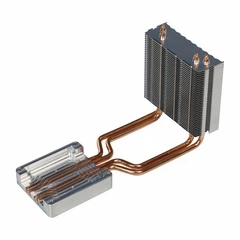
As a trusted supplier of Heat Pipe Aluminum Heat Sinks, I've witnessed firsthand the pivotal role these components play in various industries, from automotive to communication. One of the most fascinating aspects of these heat sinks is the filling fluid within the heat pipes and how it functions to dissipate heat effectively. In this blog, I'll delve into the science behind the working mechanism of the filling fluid in the heat pipe of a heat sink.
Understanding the Basics of Heat Pipes
Before we dive into the role of the filling fluid, let's briefly understand what a heat pipe is. A heat pipe is a highly efficient heat transfer device that can transfer heat from one point to another with minimal temperature difference. It consists of a sealed tube, usually made of copper or aluminum, which is evacuated and then filled with a small amount of working fluid. The inner surface of the tube is lined with a wick structure that helps in the capillary action of the fluid.
The Role of the Filling Fluid
The filling fluid, also known as the working fluid, is the heart of the heat pipe. Its primary function is to absorb heat at the evaporator end of the heat pipe and release it at the condenser end. This process is based on the principle of phase change, where the fluid changes from a liquid to a vapor and then back to a liquid.
Evaporation at the Heat Source
When the heat sink is placed in contact with a heat source, such as a CPU or a power electronics module, the heat is transferred to the evaporator end of the heat pipe. The filling fluid at this end absorbs the heat and starts to evaporate. As the fluid changes from a liquid to a vapor, it absorbs a large amount of latent heat, which is the heat required to change the phase of the substance without changing its temperature. This process effectively removes heat from the heat source and cools it down.
For example, in an Aluminum Heat Pipe Communication Module Heatsink, the filling fluid in the heat pipes absorbs the heat generated by the communication module and evaporates, preventing the module from overheating.
Vapor Flow to the Condenser
Once the fluid has evaporated, the vapor moves towards the condenser end of the heat pipe due to the pressure difference created by the evaporation process. The vapor is lighter than the liquid, so it rises towards the cooler end of the heat pipe. The wick structure inside the heat pipe helps to maintain the flow of the vapor by providing a path for it to move.
Condensation at the Cooler End
At the condenser end of the heat pipe, the vapor comes into contact with the cooler surface of the heat sink. The vapor releases the latent heat it absorbed during evaporation and condenses back into a liquid. This heat is then dissipated into the surrounding environment through the fins of the heat sink.
The condensation process is crucial for the continuous operation of the heat pipe. If the vapor does not condense properly, the pressure inside the heat pipe will increase, and the heat transfer efficiency will decrease.
Return of the Liquid to the Evaporator
After the vapor has condensed back into a liquid, the wick structure in the heat pipe plays a vital role in returning the liquid to the evaporator end. The wick structure uses capillary action to draw the liquid back to the heat source. Capillary action is the ability of a liquid to flow in narrow spaces without the assistance of, or even in opposition to, external forces like gravity.
This continuous cycle of evaporation, vapor flow, condensation, and liquid return allows the heat pipe to transfer heat efficiently from the heat source to the surrounding environment.
Factors Affecting the Performance of the Filling Fluid
The performance of the filling fluid in a heat pipe is influenced by several factors, including:
Fluid Properties
The properties of the filling fluid, such as its boiling point, latent heat of vaporization, and surface tension, play a crucial role in the heat transfer performance of the heat pipe. Different fluids have different properties, and the choice of fluid depends on the operating temperature range and the specific application of the heat sink.


For example, water is a commonly used filling fluid in heat pipes because it has a high latent heat of vaporization and a relatively low boiling point. However, it is only suitable for applications where the operating temperature is above 0°C. For applications where the temperature can drop below 0°C, other fluids, such as ammonia or methanol, may be used.
Heat Pipe Design
The design of the heat pipe, including the size, shape, and wick structure, also affects the performance of the filling fluid. A well-designed heat pipe with an optimized wick structure can enhance the capillary action and improve the heat transfer efficiency.
Operating Conditions
The operating conditions, such as the temperature, pressure, and heat load, can also impact the performance of the filling fluid. For example, if the heat load is too high, the filling fluid may not be able to absorb and transfer the heat effectively, leading to a decrease in the heat transfer efficiency.
Applications of Heat Pipes with Filling Fluids
Heat pipes with filling fluids are widely used in various industries due to their high heat transfer efficiency and reliability. Some of the common applications include:
Electronics Cooling
In the electronics industry, heat pipes are used to cool high-power components, such as CPUs, GPUs, and power electronics modules. The filling fluid in the heat pipes helps to dissipate the heat generated by these components and prevent them from overheating.
Automotive Industry
In the automotive industry, heat pipes are used in Lightweight Automotive Controller Water Cooling Plate and Automobile Car Drainage Raditor to cool the engine, battery, and electronic control units. The filling fluid in the heat pipes ensures efficient heat transfer and improves the performance and reliability of the automotive systems.
Aerospace Industry
In the aerospace industry, heat pipes are used to cool the electronic systems and avionics on aircraft and satellites. The filling fluid in the heat pipes helps to maintain the temperature of these systems within the acceptable range, ensuring their proper operation in extreme environments.
Conclusion
The filling fluid in the heat pipe of a heat sink plays a crucial role in the heat transfer process. By undergoing a phase change from liquid to vapor and back to liquid, the filling fluid absorbs and releases heat efficiently, allowing the heat sink to cool down the heat source. The performance of the filling fluid is influenced by several factors, including its properties, the heat pipe design, and the operating conditions.
As a Heat Pipe Aluminum Heat Sink supplier, we understand the importance of using high-quality filling fluids and optimizing the heat pipe design to ensure the best performance of our products. If you are looking for reliable heat sink solutions for your application, we would be happy to discuss your requirements and provide you with the most suitable products. Contact us today to start the procurement negotiation process and take advantage of our expertise in heat transfer technology.
References
- Incropera, F. P., DeWitt, D. P., Bergman, T. L., & Lavine, A. S. (2007). Fundamentals of Heat and Mass Transfer. Wiley.
- Kakaç, S., & Pramuanjaroenkij, A. (2005). Heat Pipes: Science and Technology. Taylor & Francis.
- Peterson, G. P. (1994). An Introduction to Heat Pipes: Modeling, Testing, and Applications. Wiley.