


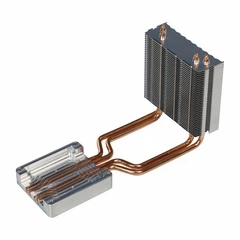
Water cooling technology has emerged as a highly effective solution for thermal management, especially in high - power applications. As a cavity water cooling plate supplier, I've witnessed firsthand the critical role that water temperature plays in the performance of these plates. In this blog post, we'll delve into the impact of water temperature on the performance of cavity water cooling plates and how it affects various aspects of their operation.
Heat Transfer Efficiency
The primary function of a cavity water cooling plate is to transfer heat from a heat - generating component to the circulating water. Heat transfer occurs through conduction and convection. The rate of heat transfer is governed by Newton's law of cooling, which states that the heat transfer rate (Q) is proportional to the temperature difference (ΔT) between the heat source and the cooling medium.
Mathematically, the heat transfer rate can be expressed as:
[Q = hA\Delta T]
where (h) is the heat transfer coefficient, (A) is the heat transfer area, and (\Delta T=T_{source}-T_{water}), with (T_{source}) being the temperature of the heat source and (T_{water}) being the temperature of the water.
When the water temperature is low, the temperature difference (\Delta T) is large. This results in a higher heat transfer rate, allowing the cooling plate to remove heat more efficiently from the heat - generating component. For example, in a high - performance computing system, a lower water temperature in the cavity water cooling plate can keep the CPU temperatures within a safe operating range, enabling the CPU to run at higher clock speeds without overheating.
Conversely, when the water temperature rises, the temperature difference (\Delta T) decreases. This reduces the heat transfer rate, and the cooling plate becomes less effective at removing heat. In extreme cases, if the water temperature gets too close to the temperature of the heat source, the cooling efficiency can drop significantly, which may lead to overheating of the component and potential damage.
Flow Characteristics
Water temperature also has a significant impact on the flow characteristics within the cavity water cooling plate. The viscosity of water is temperature - dependent. As the water temperature increases, the viscosity of water decreases.
Lower viscosity means less resistance to flow. In the context of a cavity water cooling plate, this can result in a higher flow rate for a given pumping power. A higher flow rate can enhance the convective heat transfer coefficient, as more water is available to carry away the heat. However, this also has its limitations.


If the water temperature is too high and the viscosity drops too much, the flow may become turbulent. Turbulent flow can cause uneven distribution of water within the cooling plate, leading to hot spots. These hot spots can compromise the overall cooling performance and potentially damage the heat - sensitive components.
When the water temperature is low, the higher viscosity of water can cause an increase in the pressure drop across the cooling plate. This means that more pumping power is required to maintain the desired flow rate. In some applications where power consumption is a critical factor, such as in mobile devices or electric vehicles, the increased pumping power due to low - temperature water can be a drawback.
Material Compatibility and Corrosion
Water temperature affects the chemical properties of water and can have implications for the material compatibility and corrosion of the cavity water cooling plate. Most cavity water cooling plates are made of metals such as aluminum or copper.
Higher water temperatures can accelerate the corrosion process. At elevated temperatures, the rate of oxidation of metals increases, and chemical reactions between water and the metal surface become more rapid. For example, in an Aluminum Heat Pipe Communication Module Heatsink, if the water temperature is consistently high, the aluminum may corrode more quickly, leading to the formation of rust and other corrosion products.
These corrosion products can clog the channels within the cooling plate, reducing the flow rate and heat transfer efficiency. They can also flake off and cause damage to other components in the cooling system.
On the other hand, very low water temperatures can cause issues with the sealing materials used in the cooling plate. Some sealing materials may become brittle at low temperatures, leading to leaks. Additionally, if the water freezes inside the cooling plate, the expansion of ice can cause mechanical damage to the plate structure.
Impact on System Performance in Different Applications
Automotive Applications
In the automotive industry, cavity water cooling plates are used in various components, such as the Automobile Car Drainage Raditor. The water temperature affects the engine's performance and fuel efficiency.
If the coolant water temperature in the engine cooling system is too high, the engine may overheat, leading to reduced power output and potential engine damage. On the other hand, if the water temperature is too low, the engine may not reach its optimal operating temperature, resulting in incomplete combustion and increased fuel consumption.
Energy Storage Systems
In energy storage applications, such as in Cavity - type Energy Storage Battery Water Cooling Plate, maintaining the right water temperature is crucial for the performance and lifespan of the batteries.
High water temperatures can cause the batteries to degrade more quickly, reducing their capacity and cycle life. Low water temperatures, on the other hand, can increase the internal resistance of the batteries, reducing their charge and discharge efficiency.
Controlling Water Temperature for Optimal Performance
To ensure the optimal performance of cavity water cooling plates, it's essential to control the water temperature. This can be achieved through various means, such as the use of temperature sensors and thermostatic control systems.
A temperature sensor can continuously monitor the water temperature, and the thermostatic control system can adjust the flow rate of the water or the heat input to the water to maintain the desired temperature. For example, in a large - scale data center cooling system, the control system can increase the flow rate of cold water when the temperature of the water in the cooling plates rises above a set threshold.
Conclusion
In conclusion, water temperature has a profound impact on the performance of cavity water cooling plates. It affects heat transfer efficiency, flow characteristics, material compatibility, and the overall performance of the systems in which these cooling plates are used.
As a cavity water cooling plate supplier, we understand the importance of taking into account the water temperature factor in the design and operation of our products. We are committed to providing high - quality cooling solutions that can effectively handle different water temperature conditions.
If you are looking for reliable cavity water cooling plates for your specific applications, we would be more than happy to engage in in - depth discussions with you. Whether it's for automotive, energy storage, or other high - power applications, our team of experts can provide you with tailored solutions. Contact us to start the procurement negotiation process and find the perfect cooling solution for your needs.
References
- Incropera, F. P., & DeWitt, D. P. (2002). Fundamentals of Heat and Mass Transfer. John Wiley & Sons.
- Bergman, T. L., Lavine, A. S., Incropera, F. P., & DeWitt, D. P. (2011). Introduction to Heat Transfer. John Wiley & Sons.
- Müller, A. (2015). Thermal Management in Automotive Applications. SAE International.