


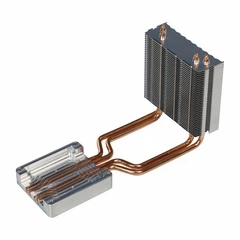
Water-cooled plate assemblies are crucial components in various industries, including automotive, electronics, and telecommunications, where efficient heat dissipation is essential for the proper functioning and longevity of equipment. As a leading supplier of water-cooled plate assemblies, I've witnessed firsthand the significant impact that water temperature can have on their performance. In this blog, I'll delve into the effects of water temperature on the performance of water-cooled plate assemblies, exploring the underlying principles and practical implications.
Heat Transfer Principles
To understand the effect of water temperature on water-cooled plate assemblies, it's essential to grasp the basic principles of heat transfer. Heat transfer occurs through three main mechanisms: conduction, convection, and radiation. In water-cooled plate assemblies, conduction and convection play the primary roles.
Conduction is the transfer of heat through a solid material, such as the metal plate of the water-cooled assembly. The rate of conduction depends on the thermal conductivity of the material, the temperature difference across the material, and the distance over which the heat is transferred. A higher thermal conductivity allows for more efficient heat transfer.
Convection, on the other hand, involves the transfer of heat through the movement of a fluid, in this case, water. As water flows through the channels in the water-cooled plate, it absorbs heat from the plate's surface and carries it away. The rate of convection depends on factors such as the flow rate of the water, its specific heat capacity, and the temperature difference between the water and the plate.
Impact of Water Temperature on Heat Transfer
The temperature of the water flowing through the water-cooled plate assembly has a direct impact on the heat transfer process. When the water temperature is lower, there is a greater temperature difference between the hot component being cooled and the water. According to Fourier's law of heat conduction and Newton's law of cooling, a larger temperature difference results in a higher rate of heat transfer.
For example, if a water-cooled plate is used to cool an electronic component operating at 80°C, and the inlet water temperature is 20°C, there is a 60°C temperature difference driving the heat transfer. However, if the inlet water temperature increases to 30°C, the temperature difference decreases to 50°C, which reduces the rate of heat transfer. As a result, the component may not be cooled as effectively, leading to higher operating temperatures.
Effect on Thermal Resistance
Thermal resistance is a measure of how much a material or system resists the flow of heat. In water-cooled plate assemblies, the thermal resistance is influenced by the water temperature. As the water temperature increases, the thermal resistance of the water-cooled system also tends to increase.
This is because the properties of water, such as its viscosity and thermal conductivity, change with temperature. As the temperature rises, the viscosity of water decreases, which can affect the flow characteristics within the channels of the water-cooled plate. A decrease in viscosity may lead to a more turbulent flow, which can enhance heat transfer to some extent. However, at the same time, the thermal conductivity of water also decreases with increasing temperature, which counteracts the positive effect of the turbulent flow. Overall, the net effect is an increase in thermal resistance, which means that more heat is retained in the system.
Influence on Component Performance and Lifespan
The performance and lifespan of the components being cooled by water-cooled plate assemblies are directly affected by the water temperature. In electronic devices, for instance, high operating temperatures can cause a variety of problems. As the temperature increases, the electrical resistance of the components may change, leading to reduced performance and potential malfunctions.
Moreover, high temperatures can accelerate the degradation of electronic components, such as semiconductors and capacitors. The increased thermal stress can cause mechanical failures, such as cracking or delamination of the component materials. By maintaining a lower water temperature, the operating temperatures of the components can be kept within a safe range, thereby improving their performance and extending their lifespan.
Practical Considerations for Water Temperature Control
In real-world applications, controlling the water temperature is crucial for optimizing the performance of water-cooled plate assemblies. There are several methods for controlling the water temperature, including the use of cooling towers, chillers, and heat exchangers.
Cooling towers are commonly used in large industrial applications to dissipate heat from the water. They work by evaporating a small portion of the water, which removes heat from the remaining water. Chillers, on the other hand, are used to actively cool the water to a specific temperature. They are often used in more precise cooling applications, such as in data centers or high-performance computing systems.
Heat exchangers can also be used to transfer heat between the water in the water-cooled plate assembly and another fluid, such as air or a secondary coolant. This can help regulate the water temperature and ensure efficient heat transfer.
Product Applications and Temperature Requirements
At our company, we offer a wide range of water-cooled plate assemblies for different applications. For example, our Lightweight Automotive Controller Water Cooling Plate is designed specifically for automotive applications. In the automotive industry, maintaining optimal operating temperatures is crucial for the performance and reliability of electronic controllers. The water temperature in automotive cooling systems needs to be carefully controlled to ensure that the controllers can operate efficiently under various driving conditions.
Our Automotive Controller Water Cooling Plate is engineered to provide effective cooling in automotive environments. The design of the plate takes into account the specific temperature requirements and flow characteristics of automotive cooling systems.
In the telecommunications industry, our Aluminum Heat Pipe Communication Module Heatsink is used to cool communication modules. These modules generate a significant amount of heat during operation, and maintaining a low operating temperature is essential for their performance and reliability. By using water-cooled plate assemblies with precise temperature control, we can ensure that the communication modules operate at optimal conditions.
Conclusion and Call to Action
In conclusion, the water temperature has a profound effect on the performance of water-cooled plate assemblies. By understanding the principles of heat transfer and the impact of water temperature on thermal resistance, component performance, and lifespan, we can design and implement effective cooling solutions.
As a supplier of high-quality water-cooled plate assemblies, we are committed to providing our customers with products that offer superior performance and reliability. If you are in need of water-cooled plate assemblies for your specific application, we invite you to contact us for a detailed discussion about your requirements. Our team of experts can help you select the right product and provide guidance on temperature control strategies to ensure optimal performance.


References
- Incropera, F. P., DeWitt, D. P., Bergman, T. L., & Lavine, A. S. (2007). Fundamentals of Heat and Mass Transfer. John Wiley & Sons.
- Kakaç, S., & Liu, H. (2002). Heat Exchangers: Selection, Rating, and Thermal Design. CRC Press.
- Tien, C. L., & Lienhard V, J. H. (1979). Statistical Thermodynamics. Hemisphere Publishing Corporation.