


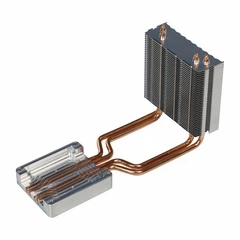
As a supplier of water-cooled plate assemblies, I often encounter inquiries about the thermal conductivity requirements for these essential components. Thermal conductivity is a critical factor that determines the efficiency and performance of water-cooled plate assemblies, especially in high-power applications where effective heat dissipation is crucial. In this blog post, I will delve into the thermal conductivity requirements for water-cooled plate assemblies, exploring the factors that influence them and the implications for different industries.
Understanding Thermal Conductivity
Thermal conductivity is a measure of a material's ability to conduct heat. It is defined as the amount of heat that can be transferred through a unit area of a material in a unit time, with a unit temperature gradient across the material. The higher the thermal conductivity of a material, the more efficiently it can transfer heat. In the context of water-cooled plate assemblies, thermal conductivity is a key parameter that affects the rate at which heat can be removed from the heat source and transferred to the cooling water.
Factors Influencing Thermal Conductivity Requirements
Several factors influence the thermal conductivity requirements for water-cooled plate assemblies. These factors include the power density of the heat source, the operating temperature range, the cooling water flow rate, and the design of the water-cooled plate.
Power Density of the Heat Source
The power density of the heat source is one of the most important factors influencing the thermal conductivity requirements for water-cooled plate assemblies. High-power applications, such as electric vehicle (EV) batteries, power electronics, and data centers, generate a significant amount of heat that needs to be dissipated efficiently. In these applications, water-cooled plate assemblies with high thermal conductivity are required to ensure that the heat can be transferred quickly from the heat source to the cooling water.
For example, in an EV battery pack, the power density can be as high as several kilowatts per liter. To maintain the battery temperature within a safe operating range, water-cooled plate assemblies with high thermal conductivity are used to transfer the heat generated by the battery cells to the cooling water. The thermal conductivity of the water-cooled plate material directly affects the temperature distribution within the battery pack, which in turn affects the battery performance and lifespan.
Operating Temperature Range
The operating temperature range is another important factor influencing the thermal conductivity requirements for water-cooled plate assemblies. Different applications have different operating temperature ranges, and the thermal conductivity of the water-cooled plate material needs to be suitable for the specific temperature range.
For example, in automotive applications, the operating temperature range can be from -40°C to 120°C. Water-cooled plate assemblies used in automotive applications need to have good thermal conductivity over this wide temperature range to ensure reliable performance. In addition, the thermal expansion coefficient of the water-cooled plate material needs to be compatible with the other components in the system to avoid thermal stress and potential damage.


Cooling Water Flow Rate
The cooling water flow rate also affects the thermal conductivity requirements for water-cooled plate assemblies. A higher cooling water flow rate can increase the heat transfer coefficient between the water-cooled plate and the cooling water, which in turn can reduce the temperature difference between the heat source and the cooling water. However, a higher cooling water flow rate also requires a higher pumping power, which can increase the energy consumption of the cooling system.
Therefore, the thermal conductivity of the water-cooled plate material needs to be optimized to balance the heat transfer performance and the pumping power requirements. In some cases, water-cooled plate assemblies with microchannels or other enhanced heat transfer structures can be used to increase the heat transfer coefficient without significantly increasing the pumping power.
Design of the Water-Cooled Plate
The design of the water-cooled plate also plays an important role in determining the thermal conductivity requirements. The shape, size, and layout of the cooling channels in the water-cooled plate can affect the flow distribution of the cooling water and the heat transfer performance.
For example, a water-cooled plate with a uniform flow distribution can ensure that all parts of the heat source are cooled evenly, which can improve the overall thermal performance. In addition, the use of high thermal conductivity materials for the water-cooled plate body and the cooling channels can further enhance the heat transfer efficiency.
Thermal Conductivity Requirements for Different Industries
The thermal conductivity requirements for water-cooled plate assemblies vary depending on the industry and the specific application. Here are some examples of the thermal conductivity requirements for different industries:
Automotive Industry
In the automotive industry, water-cooled plate assemblies are widely used in EV batteries, power electronics, and engine cooling systems. The thermal conductivity requirements for automotive water-cooled plate assemblies are relatively high due to the high power density and the wide operating temperature range.
For example, in an EV battery cooling system, the water-cooled plate assemblies need to have a thermal conductivity of at least 100 W/(m·K) to ensure efficient heat dissipation. In addition, the water-cooled plate material needs to be lightweight, corrosion-resistant, and have good mechanical properties to meet the requirements of automotive applications.
Our Lightweight Automotive Controller Water Cooling Plate is specifically designed for automotive applications, offering high thermal conductivity and excellent mechanical properties. It is made of high-quality aluminum alloy, which provides good corrosion resistance and lightweight design.
Energy Storage Industry
In the energy storage industry, water-cooled plate assemblies are used in energy storage battery systems, such as lithium-ion batteries and flow batteries. The thermal conductivity requirements for energy storage water-cooled plate assemblies are also high to ensure the safe and efficient operation of the battery systems.
For example, in a large-scale energy storage battery system, the water-cooled plate assemblies need to have a thermal conductivity of at least 200 W/(m·K) to maintain the battery temperature within a narrow range. This helps to improve the battery performance, extend the battery lifespan, and reduce the risk of thermal runaway.
Our Cavity-type Energy Storage Battery Water Cooling Plate is designed to meet the high thermal conductivity requirements of energy storage applications. It features a cavity-type structure that provides excellent heat transfer performance and uniform temperature distribution.
Electronics Industry
In the electronics industry, water-cooled plate assemblies are used in high-power electronic devices, such as servers, data centers, and power amplifiers. The thermal conductivity requirements for electronics water-cooled plate assemblies are also high to ensure the reliable operation of the electronic devices.
For example, in a data center server cooling system, the water-cooled plate assemblies need to have a thermal conductivity of at least 300 W/(m·K) to remove the heat generated by the server components efficiently. This helps to reduce the energy consumption of the cooling system and improve the overall performance of the data center.
Conclusion
In conclusion, the thermal conductivity requirements for water-cooled plate assemblies are influenced by several factors, including the power density of the heat source, the operating temperature range, the cooling water flow rate, and the design of the water-cooled plate. Different industries have different thermal conductivity requirements for water-cooled plate assemblies, depending on the specific application.
As a supplier of water-cooled plate assemblies, we understand the importance of thermal conductivity in ensuring the efficiency and performance of our products. We offer a wide range of water-cooled plate assemblies with different thermal conductivity levels to meet the diverse needs of our customers. Our products are made of high-quality materials and are designed using advanced manufacturing processes to ensure reliable performance and long service life.
If you are interested in our water-cooled plate assemblies or have any questions about thermal conductivity requirements, please feel free to contact us for procurement and negotiation. We look forward to working with you to provide the best cooling solutions for your applications.
References
- Incropera, F. P., & DeWitt, D. P. (2002). Fundamentals of Heat and Mass Transfer. John Wiley & Sons.
- Kakac, S., & Pramuanjaroenkij, A. (2005). Handbook of Single-Phase Convective Heat Transfer. John Wiley & Sons.
- Wang, L., & Mujumdar, A. S. (2007). Computational Heat Transfer: Fundamentals and Applications. Taylor & Francis.