


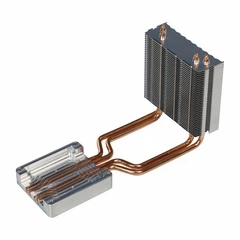
Hey there! As a supplier of Versatile Water Cooling Plates, I've been getting a lot of questions lately about how these bad boys perform in high - altitude environments. So, I thought I'd sit down and write this blog to share what I've learned and experienced.
First off, let's talk about what a Versatile Water Cooling Plate is. It's a super useful piece of tech that can be used in a bunch of different applications, like cooling CPUs, GPUs, and other high - power electronics. It works by using water as a coolant to transfer heat away from the source and dissipate it into the surrounding environment.
Now, when we move to high - altitude environments, things start to get a bit different. The most obvious change is the lower air pressure. At higher altitudes, the air is thinner, which means there are fewer air molecules per unit volume. This has a couple of significant impacts on the performance of our Versatile Water Cooling Plate.
One of the main effects is on the boiling point of water. You see, at sea level, water boils at 100°C (212°F). But as the air pressure drops with increasing altitude, the boiling point of water also decreases. For example, at an altitude of about 3000 meters (9800 feet), water boils at around 90°C (194°F). This lower boiling point can be a bit of a problem for our cooling plates.
If the temperature of the water in the cooling plate gets too close to the lower boiling point at high altitudes, there's a risk of the water boiling. When water boils, it turns into steam, and steam doesn't conduct heat as well as liquid water. This can lead to a decrease in the cooling efficiency of the plate. The cooling plate might not be able to transfer heat away from the heat source as effectively, which could cause the temperature of the electronics it's cooling to rise.
Another impact of the lower air pressure is on the heat dissipation process. The Versatile Water Cooling Plate usually relies on a combination of water circulation and air - side heat transfer. The thin air at high altitudes means that there's less air available to absorb the heat that's transferred from the water in the cooling plate. This can slow down the rate at which heat is dissipated into the environment.
To give you an idea, let's compare it to a situation at sea level. At sea level, the air is denser, and it can take in more heat from the cooling plate. But at high altitudes, the thinner air has a lower heat - carrying capacity. So, even if the water in the cooling plate is doing its job of transferring heat from the electronics, the air might not be able to take that heat away as quickly.
But don't worry! We've come up with some solutions to deal with these performance changes. One of the things we've done is to optimize the water circulation system in our Versatile Water Cooling Plates. By increasing the flow rate of the water, we can make sure that the heat is transferred more efficiently within the plate. This helps to counteract the effects of the lower boiling point and the slower heat dissipation in the thin air.
We've also been working on improving the air - side heat transfer mechanism. For example, we've designed our cooling plates with more efficient fins and heat - exchange surfaces. These features increase the surface area available for heat transfer between the water in the plate and the surrounding air. This way, even in the thin air at high altitudes, the cooling plate can still dissipate heat relatively effectively.
Now, let's talk about some of the products we offer that are related to our Versatile Water Cooling Plates. We have the Pure Copper CPU/GPU Multi - Purpose Heat Sink. This heat sink is made of pure copper, which is an excellent conductor of heat. It can work in conjunction with our Versatile Water Cooling Plate to provide even better cooling performance. The copper material helps to quickly transfer heat away from the CPU or GPU, and then the water cooling plate can take that heat and dissipate it.
Another great product is the CPU Aluminum Heat Pipe Heatsink. Aluminum is a lightweight and cost - effective material that also has good heat - conducting properties. The heat pipes in this heatsink help to transfer heat from the CPU to the fins, where it can be dissipated. It can be a great addition to our Versatile Water Cooling Plate system, especially in applications where weight and cost are important considerations.
We also have the High - power Air - cooled Laser Heatsink. This heatsink is designed for high - power laser applications. While it's an air - cooled heatsink, it can still work in harmony with our Versatile Water Cooling Plate. In high - altitude environments, the combination of the air - cooled heatsink and the water cooling plate can provide a more comprehensive cooling solution. The air - cooled heatsink can take care of some of the initial heat dissipation, and then the water cooling plate can handle the remaining heat more efficiently.
In conclusion, while the performance of our Versatile Water Cooling Plate does change in high - altitude environments due to the lower air pressure and thinner air, we've taken steps to address these issues. Our optimized water circulation systems and improved air - side heat transfer mechanisms help to ensure that our cooling plates can still provide effective cooling in these challenging conditions.
If you're in the market for a Versatile Water Cooling Plate or any of our related products, whether you're operating at sea level or in high - altitude areas, we'd love to have a chat with you. We can discuss your specific needs and how our products can meet them. Just reach out to us, and we'll be happy to start the conversation about your cooling requirements.


References:
- "Thermodynamics: An Engineering Approach" by Yunus A. Cengel and Michael A. Boles
- "Heat Transfer: A Practical Approach" by Yunus A. Cengel