


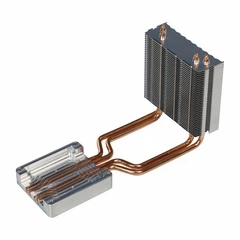
Hey there! As a supplier of heat pipe aluminum heat sinks, I often get asked about the materials that go into making these nifty cooling devices. So, I thought I'd whip up a blog post to share all the deets with you.
Aluminum: The Star Player
Let's start with aluminum, which is hands - down the most important material in heat pipe aluminum heat sinks. Aluminum is like the MVP of the heat - sinking world. It's got some amazing properties that make it perfect for this job.
First off, aluminum has excellent thermal conductivity. That means it's really good at transferring heat from one place to another. In a heat sink, this is super crucial because the whole point is to take the heat generated by a component (like a CPU in a computer) and move it away as quickly as possible.
Another great thing about aluminum is its low density. It's lightweight, which is a huge plus, especially in applications where weight matters, like in aerospace or portable electronics. You don't want your device to be weighed down by a heavy heat sink.
And let's not forget about its corrosion resistance. Aluminum forms a thin oxide layer on its surface, which protects it from rust and other forms of corrosion. This makes heat sinks last longer and perform better over time.
Heat Pipes: The Secret Sauce
Now, let's talk about heat pipes. These are the secret sauce that makes heat pipe aluminum heat sinks so effective. Heat pipes are basically sealed copper or aluminum tubes that contain a small amount of working fluid, like water or ammonia.
The way heat pipes work is pretty cool. When one end of the heat pipe is heated (usually by being in contact with the hot component), the working fluid inside evaporates. This vapor then travels to the cooler end of the heat pipe, where it condenses back into a liquid. As it condenses, it releases the heat it absorbed during evaporation. The liquid then flows back to the hot end of the heat pipe, and the cycle starts all over again.
This process is incredibly efficient at transferring heat. Heat pipes can move heat much faster than solid metal alone, which means they can help the heat sink get rid of heat more quickly and keep the component at a lower temperature.
Welding and Bonding Materials
To put all these parts together, we need some welding and bonding materials. For welding the aluminum parts, we often use aluminum filler wires. These filler wires have similar properties to the base aluminum, which ensures a strong and reliable weld.
When it comes to bonding the heat pipes to the aluminum fins or base, we use thermal interface materials (TIMs). TIMs are substances that help to improve the thermal contact between two surfaces. They fill in the tiny gaps and imperfections between the heat pipe and the aluminum, which allows heat to transfer more easily.
Surface Coatings
Sometimes, we also apply surface coatings to the heat sink. These coatings can serve different purposes. For example, a black anodized coating can be applied to increase the heat sink's emissivity. Emissivity is a measure of how well an object can radiate heat. By increasing the emissivity, the heat sink can radiate heat more effectively into the surrounding environment.


Other coatings can be used for protection. For example, a powder - coated finish can protect the heat sink from scratches, abrasion, and environmental damage.
Applications of Heat Pipe Aluminum Heat Sinks
Heat pipe aluminum heat sinks are used in a wide variety of applications. In the electronics industry, they're used to cool CPUs, GPUs, and other high - power components in computers and servers. They help to prevent these components from overheating, which can lead to performance issues and even permanent damage.
In the automotive industry, heat pipe aluminum heat sinks are used in things like Lightweight Automotive Controller Water Cooling Plate and Automobile Car Drainage Raditor. They help to keep the electronic components in cars cool, which is essential for the proper functioning of the vehicle.
In the telecommunications industry, Aluminum Heat Pipe Communication Module Heatsink are used to cool communication modules. These modules generate a lot of heat, and heat sinks are needed to keep them operating at optimal temperatures.
Why Choose Our Heat Pipe Aluminum Heat Sinks
As a supplier, we take pride in the quality of our heat pipe aluminum heat sinks. We use high - grade materials and state - of - the - art manufacturing processes to ensure that our products are reliable and perform well.
We also offer a range of customization options. Whether you need a specific size, shape, or performance level, we can work with you to create a heat sink that meets your exact requirements.
Let's Talk Business
If you're in the market for high - quality heat pipe aluminum heat sinks for your project, we'd love to hear from you. Whether you're an electronics manufacturer, an automotive engineer, or a telecoms company, we have the expertise and the products to meet your needs. Just drop us a line, and we can start discussing how we can help you with your cooling requirements.
References
- Incropera, F. P., & DeWitt, D. P. (2002). Introduction to Heat Transfer. Wiley.
- Howell, J. R., Menguc, M. P., & Siegel, R. (2010). Thermal Radiation Heat Transfer. CRC Press.