


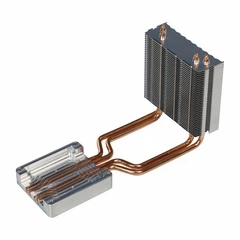
Hey there! As a supplier of water-cooled plate assemblies, I've seen firsthand the numerous advantages these nifty devices bring to the table. In this blog post, I'm gonna break down why water-cooled plate assemblies are a game-changer in various industries.


Efficient Heat Dissipation
One of the most significant advantages of water-cooled plate assemblies is their ability to dissipate heat efficiently. Unlike air-cooled systems, which rely on air circulation to carry away heat, water-cooled systems use water as a coolant. Water has a much higher specific heat capacity than air, which means it can absorb more heat energy per unit mass without a significant increase in temperature.
This property allows water-cooled plate assemblies to handle high heat loads effectively. For example, in electronic devices such as servers and high-performance computers, the components generate a substantial amount of heat during operation. Air-cooled heatsinks may struggle to keep up with the heat output, leading to increased temperatures and potential performance degradation. On the other hand, water-cooled plate assemblies can quickly transfer the heat away from the source and maintain optimal operating temperatures.
The Automobile Car Drainage Raditor is a great example of a water-cooled system in the automotive industry. It uses water to cool the engine by transferring the heat from the engine coolant to the surrounding air. This helps prevent the engine from overheating and ensures its smooth operation.
Compact Design
Another advantage of water-cooled plate assemblies is their compact design. Since water can carry more heat energy than air, the cooling system can be more compact and lightweight. This is particularly beneficial in applications where space is limited, such as in laptops, smartphones, and other portable electronic devices.
Water-cooled plate assemblies can be designed to fit into tight spaces, allowing for more efficient use of the available area. This not only helps in reducing the overall size of the device but also enables manufacturers to pack more components into a smaller form factor. For instance, in the case of a laptop, a water-cooled plate assembly can be integrated into the chassis to cool the CPU and GPU without taking up too much space.
Noise Reduction
Air-cooled systems often rely on fans to circulate air and dissipate heat. These fans can generate a significant amount of noise, especially when operating at high speeds. This can be a nuisance in environments where quiet operation is desired, such as in offices, libraries, and home theaters.
Water-cooled plate assemblies, on the other hand, typically operate silently. Since they don't require large fans to cool the components, there is no mechanical noise associated with the cooling process. This makes them an ideal choice for applications where noise reduction is a priority.
Improved Reliability
Water-cooled plate assemblies offer improved reliability compared to air-cooled systems. The consistent and efficient heat dissipation provided by water cooling helps to prevent components from overheating, which can lead to premature failure. Additionally, water-cooled systems are less prone to dust and debris accumulation, which can clog air-cooled heatsinks and reduce their effectiveness.
In high-performance applications, such as data centers and industrial equipment, reliability is crucial. Downtime can result in significant financial losses and disruptions to operations. Water-cooled plate assemblies can help minimize the risk of component failure and ensure the continuous operation of critical systems.
Customizability
Water-cooled plate assemblies can be customized to meet the specific requirements of different applications. They can be designed with different shapes, sizes, and configurations to fit various components and system layouts. This flexibility allows manufacturers to optimize the cooling performance for their specific needs.
For example, the Aluminum Heat Pipe Communication Module Heatsink can be customized to provide efficient cooling for communication modules. The heat pipes can be arranged in a specific pattern to maximize heat transfer, and the size and shape of the heatsink can be tailored to fit the module's dimensions.
Energy Efficiency
Water-cooled plate assemblies are generally more energy-efficient than air-cooled systems. Since water has a higher heat capacity than air, less energy is required to transfer the same amount of heat. This can result in lower energy consumption and reduced operating costs.
In large-scale applications, such as data centers, the energy savings can be substantial. Data centers consume a significant amount of electricity to power their servers and cooling systems. By using water-cooled plate assemblies, data center operators can reduce their energy consumption and lower their carbon footprint.
Applications in Different Industries
Water-cooled plate assemblies find applications in a wide range of industries, including automotive, electronics, aerospace, and energy storage.
In the automotive industry, water-cooled plate assemblies are used to cool engines, transmissions, and other critical components. They help improve the performance and reliability of vehicles, especially in high-performance and electric vehicles.
In the electronics industry, water-cooled plate assemblies are used in servers, high-performance computers, and other electronic devices to manage heat and ensure optimal performance. They are also used in LED lighting systems to prevent overheating and extend the lifespan of the LEDs.
In the aerospace industry, water-cooled plate assemblies are used in avionics systems, radar systems, and other electronic equipment to maintain stable operating temperatures in harsh environments.
In the energy storage industry, the Cavity-type Energy Storage Battery Water Cooling Plate is used to cool batteries in energy storage systems. This helps improve the efficiency and lifespan of the batteries, which are crucial for renewable energy integration and grid stability.
Conclusion
In conclusion, water-cooled plate assemblies offer a multitude of advantages, including efficient heat dissipation, compact design, noise reduction, improved reliability, customizability, and energy efficiency. These benefits make them a preferred choice in various industries where heat management is a critical issue.
If you're looking for high-quality water-cooled plate assemblies for your application, I'd love to have a chat with you. Whether you're in the automotive, electronics, aerospace, or energy storage industry, we can work together to find the best cooling solution for your needs. Don't hesitate to reach out and start the conversation about your procurement requirements.
References
- "Heat Transfer in Water-Cooled Systems," Thermal Engineering Handbook
- "Advantages of Water Cooling in Electronic Devices," Journal of Electronic Cooling and Thermal Control
- "Automotive Cooling Systems: Design and Performance," Automotive Engineering Magazine