


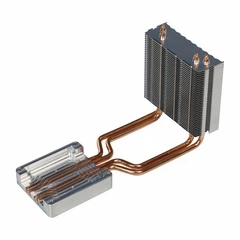
Hey there! As a supplier of Aluminum Finned Heat Sinks, I've been knee - deep in understanding how heat transfer mechanisms work in different parts of these bad boys. It's not just about slapping some fins on an aluminum block and calling it a day. There's a whole science behind it, and I'm stoked to share it with you.
Let's start by talking about the base of the aluminum finned heat sink. The base is where the heat source makes direct contact. When a hot component, like a CPU or a power transistor, sits on the base, heat is transferred from the component to the base through conduction. Conduction is all about the direct transfer of heat between molecules that are in contact with each other.
In an aluminum base, the aluminum atoms are constantly vibrating. When the hot component touches the base, the more energetic molecules in the component start to transfer their energy to the less energetic aluminum atoms in the base. Aluminum is a great conductor of heat, which means it can quickly move the heat away from the source. The rate of conduction here depends on a few factors. The thermal conductivity of aluminum is pretty high, around 205 W/(m·K). But the contact area between the heat source and the base also matters. A larger contact area allows for more molecules to interact, which speeds up the heat transfer.
Now, let's move on to the fins. The fins are the star players when it comes to increasing the heat transfer surface area. They extend out from the base, and this is where convection comes into play. Convection is the transfer of heat through the movement of fluids, which in most cases, is air.
As the base heats up, it transfers heat to the fins. The air around the fins gets heated, becomes less dense, and rises. Cooler air then moves in to take its place. This continuous cycle of hot air rising and cool air moving in is called natural convection. But in many applications, we use forced convection. That means using a fan to blow air over the fins. The fan increases the speed of the air movement, which in turn increases the rate of heat transfer.
The shape and arrangement of the fins have a huge impact on how well convection works. For example, a fin with a larger surface area will have more contact with the air, allowing for more heat to be transferred. Fins can be straight, curved, or even have complex geometries. Some of our products, like the All Aluminum Stacked Radiator, have a unique stacked fin design that maximizes the surface area for better heat transfer.


The tip of the fins is another interesting part. At the tip, the heat transfer rate is a bit different compared to the base of the fins. The temperature at the tip is usually lower than at the base because heat has been gradually transferred to the surrounding air as it moves along the fin. The heat transfer at the tip is a combination of convection and radiation.
Radiation is the transfer of heat through electromagnetic waves. All objects emit thermal radiation, and the amount of radiation depends on the temperature of the object and its emissivity. Aluminum has a relatively low emissivity, but at high temperatures, radiation can still contribute to the overall heat transfer. At the tip of the fins, where the temperature is lower, radiation is not as significant as convection, but it still plays a role.
In the middle part of the fins, the heat transfer is a balance between conduction along the fin and convection to the surrounding air. Heat is conducted from the base towards the tip of the fin, and at the same time, it's being transferred to the air through convection. The efficiency of this process depends on the fin's material properties, its thickness, and the air flow around it.
Let's take a look at some of our other products to see how these heat transfer mechanisms play out. The Black Skived Toothed Heat Sink has a unique toothed design. The teeth increase the surface area even more, which enhances convection. The black coating on the heat sink also increases its emissivity, making radiation more effective.
The Air - Cooled Laser Module Heatsink is designed specifically for laser modules. Laser modules generate a lot of heat, and this heatsink needs to be very efficient at transferring that heat away. It uses a combination of a well - designed base for conduction and fins for convection. The air - cooling aspect means that forced convection is used to quickly remove the heat from the fins.
Now, you might be wondering how all of this knowledge translates into real - world performance. Well, when we design our aluminum finned heat sinks, we take all these heat transfer mechanisms into account. We use computer simulations to model how heat will flow through different parts of the heat sink. This allows us to optimize the design, whether it's choosing the right fin shape, size, or material.
For example, if we're designing a heat sink for a high - power application, we might increase the number of fins or use a more complex fin geometry to maximize the surface area for convection. We also pay close attention to the base thickness and material to ensure efficient conduction from the heat source.
In addition to the design, the manufacturing process also plays a crucial role. We use advanced manufacturing techniques to ensure that the heat sink is of high quality. For instance, we use precision machining to create the fins with the right dimensions and surface finish. A smooth surface on the fins can reduce air resistance, which improves convection.
So, if you're in the market for an aluminum finned heat sink, you now have a better understanding of how heat transfer works in different parts of it. Whether you need a heat sink for a small electronic device or a high - power industrial application, we've got you covered.
We're always looking to work with new customers. If you're interested in our products, whether it's the All Aluminum Stacked Radiator, Black Skived Toothed Heat Sink, or Air - Cooled Laser Module Heatsink, feel free to reach out to us for a quote and to discuss your specific requirements. We're here to help you find the perfect heat sink solution for your needs.
References
- Incropera, F. P., & DeWitt, D. P. (2002). Fundamentals of Heat and Mass Transfer. John Wiley & Sons.
- Holman, J. P. (2002). Heat Transfer. McGraw - Hill.