


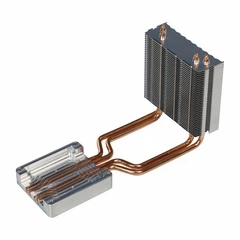
Hey there! As a supplier of cavity water cooling plates, I've seen firsthand how these nifty devices handle different heat loads. Let's dive into the details and explore how our cavity water cooling plates manage to keep things cool under various conditions.
Understanding Heat Loads
First off, what exactly is a heat load? Well, it's basically the amount of heat that needs to be removed from a system to maintain a stable temperature. Heat loads can vary widely depending on the application. For example, in an automotive controller, the heat load might be relatively low during normal driving conditions but can spike when the vehicle is under heavy load, like when climbing a steep hill or towing a trailer.
In industrial settings, heat loads can be even more extreme. Machinery such as servers, power electronics, and manufacturing equipment can generate a significant amount of heat. Our cavity water cooling plates are designed to handle these diverse heat loads effectively.
How Cavity Water Cooling Plates Work
The basic principle behind cavity water cooling plates is pretty straightforward. They consist of a series of channels or cavities through which water flows. As the water circulates, it absorbs heat from the source and carries it away. The heat is then dissipated through a heat exchanger, such as a radiator.
The design of the cavity water cooling plates plays a crucial role in their performance. The shape and size of the channels, as well as the flow rate of the water, are carefully optimized to ensure efficient heat transfer. For example, a plate with smaller channels can provide more surface area for heat transfer, but it may also increase the resistance to water flow. On the other hand, larger channels allow for a higher flow rate but may have less surface area for heat exchange.
Handling Different Heat Loads
So, how do our cavity water cooling plates handle different heat loads? Well, there are a few key factors at play.
1. Flow Rate Adjustment
One of the simplest ways to handle different heat loads is by adjusting the flow rate of the water. When the heat load is high, we can increase the flow rate to ensure that more water is available to absorb the heat. Conversely, when the heat load is low, we can reduce the flow rate to save energy.
This flow rate adjustment can be done manually or automatically. In some systems, sensors are used to monitor the temperature and adjust the flow rate accordingly. This ensures that the cooling system is always operating at an optimal level.
2. Plate Design
The design of the cavity water cooling plate itself can also be tailored to handle different heat loads. For high heat loads, we can use plates with a higher density of channels or a larger surface area. This allows for more efficient heat transfer and helps to keep the temperature under control.
On the other hand, for lower heat loads, we can use plates with a simpler design. This reduces the cost and complexity of the cooling system without sacrificing performance.
3. Material Selection
The material used to make the cavity water cooling plate is another important factor. Different materials have different thermal conductivity properties, which can affect the efficiency of heat transfer. For example, aluminum is a popular choice for cooling plates because it has a high thermal conductivity and is relatively lightweight.
In some cases, we may also use materials with enhanced thermal properties, such as copper or graphite. These materials can provide even better heat transfer performance, but they may also be more expensive.
Real - World Applications
Let's take a look at some real - world applications where our cavity water cooling plates are used to handle different heat loads.
Automotive Applications
In the automotive industry, our Lightweight Automotive Controller Water Cooling Plate and Automotive Controller Water Cooling Plate are designed to keep the electronic components of the vehicle cool. These components, such as the engine control unit (ECU) and the power electronics, generate a significant amount of heat during operation.
During normal driving, the heat load is relatively low, and the cooling plates can handle it with a moderate flow rate of water. However, when the vehicle is under heavy load, such as during acceleration or high - speed driving, the heat load increases significantly. Our cooling plates are able to adjust to these changes by increasing the flow rate of water and ensuring that the components stay within a safe temperature range.
Industrial Applications
In industrial settings, our cavity water cooling plates are used to cool a wide range of equipment, including servers, power electronics, and manufacturing machinery. For example, in a data center, servers generate a large amount of heat. Our cooling plates can be used to remove this heat and keep the servers running efficiently.
The heat load in a data center can vary depending on the number of servers in operation and the workload. Our cooling plates are designed to handle these fluctuations by adjusting the flow rate of water and optimizing the heat transfer process.


Advantages of Our Cavity Water Cooling Plates
There are several advantages to using our cavity water cooling plates to handle different heat loads.
1. Efficiency
Our cooling plates are designed to provide efficient heat transfer, which means that they can remove heat quickly and effectively. This helps to keep the temperature of the system under control and prevents overheating.
2. Customizability
We can customize our cavity water cooling plates to meet the specific needs of different applications. Whether it's a high - heat load industrial application or a low - heat load automotive application, we can design a cooling plate that is optimized for the job.
3. Durability
Our cooling plates are made from high - quality materials that are designed to withstand the rigors of different environments. They are resistant to corrosion and can operate reliably for long periods of time.
Contact Us for Your Cooling Needs
If you're looking for a reliable solution to handle different heat loads, our cavity water cooling plates are the way to go. We have a wide range of products available, including the Automobile Car Drainage Raditor, that can be tailored to your specific requirements.
Whether you're in the automotive, industrial, or any other industry, we can provide you with the right cooling solution. Don't hesitate to reach out to us for more information or to discuss your procurement needs. We're here to help you keep your systems cool and running smoothly.
References
- Incropera, F. P., DeWitt, D. P., Bergman, T. L., & Lavine, A. S. (2007). Fundamentals of Heat and Mass Transfer. Wiley.
- Cengel, Y. A., & Ghajar, A. J. (2015). Heat and Mass Transfer: Fundamentals and Applications. McGraw - Hill Education.