


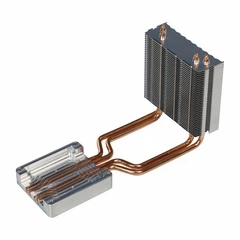
When it comes to selecting the right size of a heat pipe aluminum heat sink, there are multiple factors that need to be taken into account. As a supplier of heat pipe aluminum heat sinks, I've encountered various customers with different requirements. In this blog, I'll share some insights on how to make an informed decision about the size of a heat pipe aluminum heat sink.
Understanding the Basics of Heat Pipe Aluminum Heat Sinks
Before delving into the sizing process, it's essential to understand what a heat pipe aluminum heat sink is. Heat pipe aluminum heat sinks are cooling devices that combine the high thermal conductivity of heat pipes with the excellent heat dissipation properties of aluminum. Heat pipes work by transferring heat from a heat source to a heat sink, where it is dissipated into the surrounding environment. Aluminum, on the other hand, is a lightweight and cost - effective material that has good thermal conductivity.
The size of a heat pipe aluminum heat sink plays a crucial role in its performance. A heat sink that is too small may not be able to dissipate the heat effectively, leading to overheating of the components. Conversely, a heat sink that is too large can be expensive, take up unnecessary space, and may not be practical for the application.
Factors to Consider When Choosing the Size
1. Heat Dissipation Requirements
The first and most important factor is the amount of heat that needs to be dissipated. This is typically measured in watts. You need to know the power consumption of the component that you are cooling. For example, if you are cooling a high - performance CPU, it may generate a significant amount of heat, say 100 - 200 watts. In such a case, you'll need a larger heat sink with more heat pipes and a larger surface area to dissipate the heat.
To calculate the heat dissipation requirements accurately, you can refer to the datasheet of the component. The datasheet usually provides information about the maximum power consumption and the recommended operating temperature. Based on this information, you can estimate the heat that needs to be removed from the component.
2. Available Space
The physical space where the heat sink will be installed is another critical factor. In some applications, such as in small electronic devices or compact server racks, space is limited. In these cases, you need to choose a heat sink that can fit within the available space while still providing sufficient heat dissipation.
You should measure the dimensions of the area where the heat sink will be installed, including the length, width, and height. Make sure to account for any clearance requirements for other components, such as cables or connectors. For example, if you are installing a heat sink in a laptop, the height of the heat sink is usually restricted by the thickness of the laptop chassis.
3. Airflow
The airflow in the environment where the heat sink will be used also affects the size selection. If there is good natural or forced airflow, a smaller heat sink may be sufficient. Forced airflow can be provided by fans, which can increase the heat transfer rate by blowing air over the heat sink fins.
In an environment with poor airflow, such as a sealed enclosure, a larger heat sink may be required to compensate for the lack of air movement. You can also consider using heat sinks with fins that are designed to enhance the airflow, such as pin - fin heat sinks or heat sinks with optimized fin geometries.
4. System Requirements and Compatibility
The heat sink should be compatible with the overall system requirements. This includes factors such as the mounting mechanism, the thermal interface material, and the electrical compatibility. For example, some heat sinks may require a specific type of mounting bracket or a particular thermal paste to ensure proper heat transfer.
You also need to consider the long - term reliability and maintenance requirements of the system. A heat sink that is easy to install and maintain can save time and cost in the long run.
Specific Applications and Size Recommendations
1. Computer Applications
In desktop computers, CPUs and GPUs are common components that require heat sinks. For a mid - range CPU that generates around 65 - 95 watts of heat, a heat sink with a size of around 120 - 140mm in height and a base area of 80 - 100mm square may be sufficient. High - end CPUs that generate over 100 watts may require larger heat sinks with multiple heat pipes and a larger surface area.
For GPUs, the heat dissipation requirements can be even higher, especially in gaming or professional graphics applications. A GPU heat sink may need to be larger and more powerful, with a larger number of heat pipes and fins to dissipate the heat effectively.
2. Industrial Applications
In industrial applications, such as power electronics and motor drives, the heat dissipation requirements can vary widely. Some industrial components may generate several hundred watts of heat. In these cases, large - scale heat pipe aluminum heat sinks with a high number of heat pipes and a large surface area are often required.
The size of the heat sink in industrial applications is also influenced by the environmental conditions, such as temperature, humidity, and dust. In harsh environments, a heat sink with a more robust design and better protection against dust and moisture may be necessary.
3. Automotive Applications
Automotive applications have their own unique requirements. Components such as Automotive Controller Water Cooling Plate and Lightweight Automotive Controller Water Cooling Plate need to be cooled effectively in a limited space. The size of the heat sink in automotive applications is often restricted by the available space in the vehicle and the need for lightweight components.
For example, a heat sink for an automotive controller may need to be compact and lightweight while still providing sufficient heat dissipation. The heat sink may also need to be designed to withstand vibrations and temperature variations that are common in automotive environments.


Other Related Products
Apart from heat pipe aluminum heat sinks, we also offer other related products such as Cavity - type Energy Storage Battery Water Cooling Plate. These products are designed to meet the specific cooling requirements of different applications.
Conclusion
Choosing the right size of a heat pipe aluminum heat sink is a complex process that requires careful consideration of multiple factors. By understanding the heat dissipation requirements, available space, airflow, and system compatibility, you can make an informed decision.
If you are in the market for a heat pipe aluminum heat sink or any of our related products, we encourage you to contact us for a detailed discussion about your specific requirements. Our team of experts can provide you with professional advice and help you select the most suitable product for your application.
References
- Incropera, F. P., & DeWitt, D. P. (2002). Fundamentals of Heat and Mass Transfer. John Wiley & Sons.
- Kraus, A. D., Aziz, A., & Welty, J. R. (2001). Extended Surface Heat Transfer. Wiley - Interscience.