


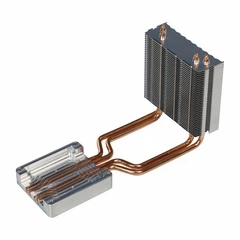
As a provider of water-cooled plate assemblies, I'm often asked about the manufacturing process of these essential components. Water-cooled plates play a crucial role in various industries, from automotive to energy storage, by efficiently dissipating heat and maintaining optimal operating temperatures. In this blog post, I'll take you through the step-by-step process of manufacturing water-cooled plate assemblies, sharing insights into the techniques and technologies we use to ensure high-quality products.
Design and Engineering
The manufacturing process of water-cooled plate assemblies begins with the design and engineering phase. This is where our team of experts works closely with customers to understand their specific requirements and develop a customized solution. We consider factors such as the application, heat dissipation requirements, space constraints, and material compatibility to create a design that meets or exceeds the customer's expectations.
Using advanced computer-aided design (CAD) software, we create detailed 3D models of the water-cooled plate assemblies. These models allow us to visualize the design, analyze its performance, and make any necessary adjustments before moving on to the manufacturing stage. We also conduct finite element analysis (FEA) to simulate the heat transfer and fluid flow within the water-cooled plates, ensuring that they can effectively dissipate heat under real-world conditions.
Material Selection
Once the design is finalized, the next step is to select the appropriate materials for the water-cooled plate assemblies. The choice of materials depends on several factors, including the application, operating temperature, corrosion resistance, and cost. At our company, we typically use aluminum alloys for water-cooled plates due to their excellent thermal conductivity, lightweight, and corrosion resistance.
Aluminum alloys offer several advantages over other materials, such as copper and steel. They have a high thermal conductivity, which allows for efficient heat transfer from the heat source to the coolant. They are also lightweight, which is important in applications where weight is a critical factor, such as automotive and aerospace. Additionally, aluminum alloys are corrosion-resistant, which helps to extend the lifespan of the water-cooled plates and reduce maintenance costs.
Manufacturing Processes
After the materials are selected, the manufacturing process begins. There are several manufacturing processes that can be used to produce water-cooled plate assemblies, including machining, stamping, brazing, and welding. The choice of manufacturing process depends on the design, complexity, and quantity of the water-cooled plates.
Machining
Machining is a common manufacturing process used to produce water-cooled plates. It involves using computer numerical control (CNC) machines to cut, drill, and mill the aluminum alloy to create the desired shape and features. Machining allows for high precision and accuracy, making it suitable for producing complex water-cooled plate designs.
During the machining process, the aluminum alloy is first cut into the desired size and shape using a CNC milling machine. The machine uses a cutting tool to remove material from the aluminum alloy, creating the channels and fins that are necessary for heat transfer. The channels and fins are designed to maximize the surface area of the water-cooled plate, allowing for efficient heat transfer from the heat source to the coolant.
Stamping
Stamping is another manufacturing process used to produce water-cooled plates. It involves using a stamping press to cut and shape the aluminum alloy into the desired shape and features. Stamping is a high-speed manufacturing process that is suitable for producing large quantities of water-cooled plates.
During the stamping process, the aluminum alloy is first placed between two dies, which are shaped to the desired design of the water-cooled plate. The stamping press then applies pressure to the dies, cutting and shaping the aluminum alloy into the desired shape. The stamped water-cooled plates are then trimmed and cleaned to remove any excess material.
Brazing
Brazing is a joining process used to connect the different components of the water-cooled plate assembly. It involves using a filler metal to join the aluminum alloy components together at a temperature below the melting point of the base metal. Brazing is a strong and reliable joining method that is suitable for producing water-cooled plates with high thermal conductivity.
During the brazing process, the aluminum alloy components are first cleaned and fluxed to remove any impurities and oxides from the surface. The filler metal is then placed between the components, and the assembly is heated to a temperature above the melting point of the filler metal. The filler metal melts and flows into the joint, creating a strong and durable bond between the components.


Welding
Welding is another joining process used to connect the different components of the water-cooled plate assembly. It involves using a welding machine to melt and fuse the aluminum alloy components together at a temperature above the melting point of the base metal. Welding is a fast and efficient joining method that is suitable for producing water-cooled plates with high strength and durability.
During the welding process, the aluminum alloy components are first cleaned and prepared for welding. The welding machine then applies heat and pressure to the components, melting and fusing them together. The welded joint is then cooled and inspected to ensure that it is strong and free of defects.
Quality Control
Quality control is an essential part of the manufacturing process for water-cooled plate assemblies. At our company, we have a rigorous quality control system in place to ensure that all of our products meet or exceed the highest standards of quality and performance.
We use a variety of inspection techniques to test the water-cooled plate assemblies, including visual inspection, dimensional inspection, pressure testing, and thermal performance testing. Visual inspection involves examining the water-cooled plates for any visible defects, such as cracks, scratches, or porosity. Dimensional inspection involves measuring the dimensions of the water-cooled plates to ensure that they meet the design specifications. Pressure testing involves applying pressure to the water-cooled plates to check for any leaks or defects in the joints. Thermal performance testing involves measuring the heat transfer and fluid flow within the water-cooled plates to ensure that they can effectively dissipate heat under real-world conditions.
Assembly and Testing
Once the water-cooled plates are manufactured and inspected, they are ready for assembly and testing. The assembly process involves connecting the water-cooled plates to the other components of the cooling system, such as the coolant tubes, pumps, and radiators. We use a variety of assembly techniques, including brazing, welding, and mechanical fastening, to ensure that the water-cooled plate assemblies are securely connected and leak-free.
After the assembly is complete, the water-cooled plate assemblies are tested to ensure that they are functioning properly. We use a variety of testing techniques, including pressure testing, flow testing, and thermal performance testing, to verify the performance of the water-cooled plate assemblies. The testing process allows us to identify any issues or defects in the water-cooled plate assemblies and make any necessary adjustments before they are shipped to the customer.
Conclusion
In conclusion, the manufacturing process of water-cooled plate assemblies is a complex and multi-step process that requires careful planning, design, and execution. At our company, we have the expertise and experience to produce high-quality water-cooled plate assemblies that meet or exceed the highest standards of quality and performance. We use advanced manufacturing technologies and techniques to ensure that our products are efficient, reliable, and durable.
If you're interested in learning more about our water-cooled plate assemblies or have any questions about the manufacturing process, please don't hesitate to contact us. We'd be happy to discuss your specific requirements and provide you with a customized solution. You can also visit our website to learn more about our products and services: Cavity-type Energy Storage Battery Water Cooling Plate, Automobile Car Drainage Raditor, Lightweight Automotive Controller Water Cooling Plate.
References
- "Aluminum Alloys for Heat Exchangers." ASM International, 2006.
- "Heat Transfer in Water-Cooled Plates." John Wiley & Sons, 2012.
- "Manufacturing Processes for Water-Cooled Plate Assemblies." Society of Manufacturing Engineers, 2015.