


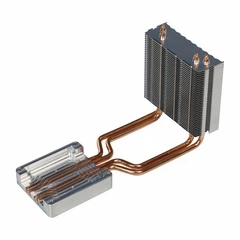
Hey there! As a supplier of Black Skived Toothed Heat Sinks, I've been getting a lot of questions about how altitude affects the performance of these nifty little devices. So, I thought I'd take some time to break it down for you.
First off, let's talk a bit about what a Black Skived Toothed Heat Sink is and why it's so cool (pun intended). A Black Skived Toothed Heat Sink is a type of heat sink made from high - quality aluminum. The "skived toothed" design means that it has these thin, tooth - like fins that are created through a skiving process. This design maximizes the surface area of the heat sink, which in turn helps to dissipate heat more efficiently.
Now, let's get into the nitty - gritty of how altitude comes into play. At higher altitudes, the air density decreases. You've probably noticed this if you've ever gone hiking in the mountains – it's harder to breathe because there's less oxygen per unit of volume. This decrease in air density has a significant impact on the performance of heat sinks.
Convective Heat Transfer
One of the main ways heat sinks work is through convective heat transfer. When the heat sink is hot, it heats up the air around it. The hot air then rises, and cooler air moves in to take its place. This continuous cycle of hot air rising and cool air replacing it is called natural convection. At higher altitudes, because the air density is lower, there are fewer air molecules available to absorb and carry away the heat from the heat sink. This means that the rate of convective heat transfer decreases.
Think of it like trying to scoop up water with a ladle. If the water is thick and dense, you can get a lot of it in one go. But if it's more spread out, like a mist, you'll have a harder time getting the same amount. Similarly, with less - dense air at high altitudes, the heat sink has a harder time transferring its heat to the air.


Radiation Heat Transfer
Radiation is another way heat is transferred from the heat sink. All objects above absolute zero emit thermal radiation. The black coating on the Black Skived Toothed Heat Sink actually helps in this regard. Black surfaces are better at absorbing and emitting radiation compared to lighter - colored surfaces.
However, altitude doesn't have a direct impact on radiation heat transfer. Radiation occurs through electromagnetic waves, and it doesn't rely on the presence of air molecules. So, when it comes to radiation, the performance of the heat sink remains relatively stable regardless of altitude. But since convective heat transfer is reduced at high altitudes, the overall cooling performance of the heat sink still takes a hit.
Impact on Performance Metrics
The decrease in convective heat transfer due to lower air density at high altitudes affects several key performance metrics of the Black Skived Toothed Heat Sink.
- Thermal Resistance: Thermal resistance is a measure of how well a material resists the flow of heat. As the convective heat transfer decreases at high altitudes, the thermal resistance of the heat sink increases. This means that it becomes more difficult for the heat sink to transfer heat from the source (like a CPU or a power transistor) to the surrounding air.
- Temperature Rise: With increased thermal resistance, the temperature of the heat sink and the device it's cooling will rise. For example, if a heat sink is designed to keep a CPU at a certain temperature at sea level, at a high altitude, the CPU temperature may exceed that target. This can lead to reduced performance and even damage to the device over time if the temperature gets too high.
Real - World Applications
This information about altitude and heat sink performance is crucial in various real - world applications. For instance, in aviation and aerospace industries, electronic components are often used at high altitudes. These components generate a lot of heat and need to be cooled effectively. A Black Skived Toothed Heat Sink that works well at sea level may not perform as expected in an aircraft flying at 30,000 feet.
In mountainous regions, data centers or communication equipment may also face challenges related to altitude. Since these facilities rely on heat sinks to keep their servers and other components cool, understanding how altitude affects heat sink performance is essential for maintaining optimal operation.
Mitigating the Effects of Altitude
So, what can be done to mitigate the effects of altitude on the performance of a Black Skived Toothed Heat Sink?
- Increasing Surface Area: One option is to increase the surface area of the heat sink even more. This can be done by adding more fins or making the existing fins taller. A larger surface area provides more space for heat transfer, which can help compensate for the reduced convective heat transfer at high altitudes.
- Forced Convection: Instead of relying solely on natural convection, forced convection can be used. This involves using fans to blow air over the heat sink. The fans can increase the air flow rate and help overcome the reduced air density at high altitudes.
Related Products
If you're looking for other heat - dissipation solutions, we also offer some great alternatives. The DCC Power Control High - Power Heatsink is designed for high - power applications. It can handle a large amount of heat and is suitable for a wide range of environments, including high - altitude areas.
Another option is the Combination Aluminum Water Cooling Radiator. This radiator combines the advantages of air and water cooling, providing efficient heat dissipation even in challenging conditions.
Conclusion
In conclusion, altitude has a significant impact on the performance of a Black Skived Toothed Heat Sink, mainly due to the decrease in air density and the resulting reduction in convective heat transfer. However, by understanding these effects and taking appropriate measures, such as increasing surface area or using forced convection, it's possible to maintain the functionality of the heat sink at high altitudes.
If you're in the market for a high - quality heat sink for your application, whether it's at sea level or in the mountains, we've got you covered. Our Black Skived Toothed Heat Sinks are designed with the latest technology to provide efficient heat dissipation. Don't hesitate to reach out if you have any questions or if you're interested in a purchase. We're here to help you find the perfect heat - management solution for your needs.
References
- Incropera, F. P., DeWitt, D. P., Bergman, T. L., & Lavine, A. S. (2007). Fundamentals of Heat and Mass Transfer. Wiley.
- Holman, J. P. (2010). Heat Transfer. McGraw - Hill.