


What are the characteristics of high - performance cooling system components?
In the realm of modern technology, high - performance cooling system components are of paramount importance. As a leading supplier of Cooling System Components, I have witnessed firsthand the evolution and significance of these components in various industries. This blog post aims to delve into the key characteristics that define high - performance cooling system components.


1. High Thermal Conductivity
One of the most fundamental characteristics of high - performance cooling system components is high thermal conductivity. Materials with high thermal conductivity can transfer heat more efficiently from the heat source to the cooling medium. For example, copper and aluminum are commonly used in cooling system components due to their excellent thermal conductivity.
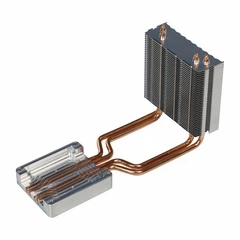
Copper has a thermal conductivity of around 400 W/(m·K), while aluminum has a thermal conductivity of approximately 200 - 240 W/(m·K). These materials allow heat to be quickly dissipated, preventing overheating of the equipment. Our Aluminum Heat Pipe Communication Module Heatsink is a prime example of a component that leverages the high thermal conductivity of aluminum. The heat pipe technology further enhances the heat transfer process, making it highly effective in cooling communication modules.
2. Excellent Heat Dissipation Design
High - performance cooling system components often feature excellent heat dissipation designs. This includes fins, heat pipes, and channels that are carefully engineered to maximize the surface area for heat transfer. Fins are thin, extended surfaces that increase the contact area between the component and the surrounding air or coolant, allowing for more efficient heat exchange.
Heat pipes are another crucial design element. They work on the principle of phase change, where a working fluid inside the pipe evaporates at the hot end, absorbs heat, and then condenses at the cold end, releasing the heat. This closed - loop system enables rapid heat transfer over long distances with minimal energy consumption. Our Cavity - type Energy Storage Battery Water Cooling Plate incorporates a well - designed water - cooling channel system. The cavity design allows for uniform coolant flow, ensuring efficient heat dissipation from the energy storage batteries.
3. Durability and Reliability
In industrial and automotive applications, cooling system components need to be durable and reliable. They are often exposed to harsh environments, including high temperatures, vibrations, and chemical substances. Therefore, high - performance components are made from high - quality materials that can withstand these conditions.
For example, in automotive cooling systems, components like the Automobile Car Drainage Raditor are designed to resist corrosion and mechanical stress. The radiator is typically made of aluminum alloy, which is lightweight yet strong and corrosion - resistant. This ensures a long service life and reliable performance, even in demanding driving conditions.
4. Compatibility and Customizability
High - performance cooling system components should be compatible with a wide range of equipment and systems. This allows for easy integration into existing setups without the need for extensive modifications. At the same time, customization is also an important aspect, as different applications may have unique cooling requirements.
We understand the importance of both compatibility and customizability. Our team of engineers can work closely with customers to design and manufacture cooling system components that meet their specific needs. Whether it's a small - scale electronic device or a large - scale industrial machine, we can provide tailored solutions that ensure optimal cooling performance.
5. Energy Efficiency
In today's energy - conscious world, energy efficiency is a key characteristic of high - performance cooling system components. Components that consume less energy while providing effective cooling can significantly reduce operating costs and environmental impact.
Advanced technologies, such as variable - speed fans and intelligent control systems, are often incorporated into cooling system components to achieve energy efficiency. These technologies allow the components to adjust their operation based on the actual cooling demand, reducing unnecessary energy consumption.
6. Low Noise Operation
In many applications, especially in consumer electronics and office environments, low noise operation is highly desirable. High - performance cooling system components are designed to minimize noise generation during operation.
This can be achieved through the use of low - noise fans, optimized airflow designs, and vibration - damping materials. By reducing noise levels, these components provide a more comfortable and quiet working or living environment.
7. Compact Size
With the trend towards miniaturization in many industries, high - performance cooling system components need to be compact in size. A smaller footprint allows for more efficient use of space, especially in devices where space is limited.
Despite their small size, these components still need to provide effective cooling performance. Our engineers use advanced manufacturing techniques and innovative designs to achieve a balance between size and performance, ensuring that our components can meet the requirements of modern, space - constrained applications.
In conclusion, high - performance cooling system components possess a combination of characteristics, including high thermal conductivity, excellent heat dissipation design, durability, compatibility, energy efficiency, low noise operation, and compact size. As a supplier of Cooling System Components, we are committed to providing our customers with products that embody these characteristics.
If you are in need of high - performance cooling system components for your application, we invite you to contact us for a detailed discussion. Our team of experts will be happy to assist you in selecting the most suitable components and providing customized solutions.
References
- Incropera, F. P., & DeWitt, D. P. (2002). Fundamentals of Heat and Mass Transfer. Wiley.
- Holman, J. P. (2002). Heat Transfer. McGraw - Hill.
- ASHRAE Handbook: Fundamentals. American Society of Heating, Refrigerating and Air - Conditioning Engineers.