


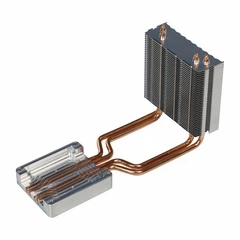
As a supplier of Aluminum Finned Heat Sinks, I've witnessed firsthand the critical role that material purity plays in the performance of these essential components. In this blog, I'll delve into how the material purity of aluminum in a heat sink affects its performance, exploring the science behind it and sharing insights based on my experience in the industry.
The Basics of Aluminum Purity
Aluminum is a widely used material in heat sinks due to its excellent thermal conductivity, lightweight nature, and corrosion resistance. However, not all aluminum is created equal. The purity of aluminum refers to the percentage of pure aluminum in the material, with higher purity levels indicating a greater concentration of aluminum and fewer impurities.
Aluminum is typically classified by its purity level, with the most common grades being 1000, 3000, 5000, and 6000 series. The 1000 series is the purest, with a minimum aluminum content of 99%, while the other series contain varying amounts of alloying elements such as copper, magnesium, and silicon. These alloying elements are added to improve specific properties of the aluminum, such as strength, corrosion resistance, and formability.
Impact of Purity on Thermal Conductivity
One of the most important factors in heat sink performance is thermal conductivity, which is a measure of a material's ability to conduct heat. The higher the thermal conductivity, the more efficiently the heat sink can transfer heat away from the source.
Pure aluminum has a very high thermal conductivity, making it an ideal material for heat sinks. As the purity of aluminum decreases and alloying elements are added, the thermal conductivity of the material also decreases. This is because the alloying elements disrupt the regular lattice structure of the aluminum, which reduces the ability of the material to conduct heat.
For example, the 1000 series aluminum, with its high purity, has a thermal conductivity of around 220 W/mK. In contrast, the 6000 series aluminum, which contains alloying elements such as magnesium and silicon, has a thermal conductivity of around 180 - 200 W/mK. This difference in thermal conductivity can have a significant impact on the performance of the heat sink, especially in applications where high heat transfer rates are required.
Effect on Heat Dissipation
The purity of aluminum also affects the heat dissipation capabilities of the heat sink. Heat dissipation is the process by which heat is transferred from the heat source to the surrounding environment. A heat sink with high heat dissipation capabilities can effectively remove heat from the source, preventing overheating and ensuring the proper functioning of the device.
Higher purity aluminum heat sinks are more efficient at dissipating heat due to their higher thermal conductivity. They can transfer heat more quickly from the heat source to the fins of the heat sink, where it can be dissipated into the surrounding air. In contrast, heat sinks made from lower purity aluminum may struggle to transfer heat effectively, leading to higher operating temperatures and reduced performance.
Influence on Mechanical Properties
In addition to thermal conductivity and heat dissipation, the purity of aluminum also affects the mechanical properties of the heat sink. Mechanical properties such as strength, hardness, and ductility are important for ensuring the durability and reliability of the heat sink.
Pure aluminum is relatively soft and ductile, which makes it easy to form into complex shapes. However, it may not have the strength required for some applications. Alloying elements are added to aluminum to improve its mechanical properties, making it stronger and more resistant to deformation.
For example, the 6000 series aluminum is commonly used in heat sinks because it offers a good balance of thermal conductivity and mechanical strength. The alloying elements in the 6000 series aluminum, such as magnesium and silicon, increase the strength and hardness of the material, while still maintaining a relatively high thermal conductivity.
Considerations for Different Applications
When selecting a heat sink, it's important to consider the specific requirements of the application. Different applications may have different requirements for thermal conductivity, mechanical properties, and cost.
In applications where high thermal conductivity is critical, such as in high-power electronics or laser systems, heat sinks made from high-purity aluminum may be the best choice. These heat sinks can provide efficient heat transfer and help to prevent overheating. For example, our Air-Cooled Laser Module Heatsink is designed to meet the high thermal requirements of laser modules, using high-purity aluminum to ensure optimal performance.
In applications where mechanical strength is more important, such as in automotive or industrial applications, heat sinks made from alloyed aluminum may be more suitable. These heat sinks can withstand the rigors of the application and provide long-term reliability. For instance, our DCC Power Control Stacked Dual-Sided Heatsink is designed for power control applications, where both thermal performance and mechanical strength are essential.
In applications where cost is a major consideration, heat sinks made from lower purity aluminum or alloyed aluminum may be a more economical choice. These heat sinks can still provide adequate thermal performance for many applications, while offering a lower cost solution. Our Combination Water Cooling Radiator is a cost-effective option for applications that require both water cooling and air cooling, using a combination of aluminum materials to provide efficient heat transfer at a reasonable cost.
Conclusion
In conclusion, the material purity of aluminum in a heat sink has a significant impact on its performance. Higher purity aluminum offers better thermal conductivity and heat dissipation capabilities, while alloyed aluminum can provide improved mechanical properties. When selecting a heat sink, it's important to consider the specific requirements of the application, including thermal conductivity, mechanical strength, and cost.
As a supplier of Aluminum Finned Heat Sinks, we understand the importance of material purity in heat sink performance. We offer a wide range of heat sinks made from different grades of aluminum, to meet the diverse needs of our customers. Whether you're looking for a high-performance heat sink for a high-power application or a cost-effective solution for a general-purpose application, we can provide you with the right product.
If you're interested in learning more about our Aluminum Finned Heat Sinks or have any questions about heat sink performance, please feel free to contact us. We'd be happy to discuss your specific requirements and help you find the best solution for your application.


References
- Incropera, F. P., & DeWitt, D. P. (2002). Fundamentals of Heat and Mass Transfer. John Wiley & Sons.
- Holman, J. P. (2002). Heat Transfer. McGraw-Hill.
- ASM Handbook, Volume 2: Properties and Selection: Nonferrous Alloys and Special-Purpose Materials. ASM International.