


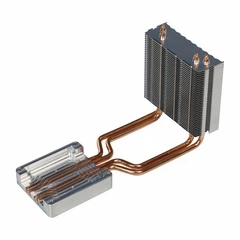
Hey there! I'm a supplier of cavity water cooling plates, and today I wanna dig into how the installation orientation of these plates can impact their performance.
First off, let's quickly go over what a cavity water cooling plate is. It's a key component in many cooling systems, especially in automotive and some high - tech applications. The basic idea is that water flows through the cavities in the plate, absorbing heat from the object it's in contact with and then carrying that heat away.
Now, let's talk about different installation orientations and their effects.
Horizontal Installation
When a cavity water cooling plate is installed horizontally, there are a few things to consider. One of the big advantages is that it often allows for a more even distribution of water flow. Gravity doesn't play a huge role in causing uneven water levels within the cavities. This means that the cooling effect can be more consistent across the entire surface of the plate.
For example, in an automotive controller, a horizontally installed Automotive Controller Water Cooling Plate can ensure that all the sensitive electronic components get the same level of cooling. This is super important because uneven cooling can lead to some parts of the controller overheating while others are at the right temperature. Over time, this uneven wear can reduce the lifespan of the controller.
However, horizontal installation also has its drawbacks. If there are any air bubbles trapped in the water channels, they tend to stay there. Air bubbles act as insulators, reducing the contact between the water and the plate's inner surface. This, in turn, decreases the heat transfer efficiency. And in a high - performance system, even a small reduction in efficiency can have a significant impact.
Vertical Installation
Vertical installation of a cavity water cooling plate has a very different dynamic compared to horizontal. Gravity becomes a major factor here. Water naturally flows downwards, which can help to flush out any air bubbles that might be present in the channels. This is a big plus because it improves the overall heat transfer efficiency.
In the case of a Lightweight Automotive Controller Water Cooling Plate, vertical installation can be beneficial. The lightweight design might be more prone to heat build - up, and the ability to get rid of air bubbles quickly can keep the cooling system working at its best.
But there's a catch. The water flow might not be as uniform in a vertical orientation. The bottom part of the plate might receive more water flow than the top part. This can lead to a temperature gradient across the plate, with the bottom being cooler than the top. If the object being cooled is sensitive to temperature differences, this could cause problems.
Inclined Installation
An inclined installation is kind of a middle - ground between horizontal and vertical. It combines some of the advantages of both. The inclination can help to move air bubbles out of the channels, similar to vertical installation. At the same time, it can also provide a more even water distribution compared to a fully vertical setup.
For an Automobile Car Drainage Raditor, an inclined cavity water cooling plate might be a great choice. It can ensure efficient cooling while also dealing with the issue of air bubbles.
Impact on Material and Design
The installation orientation also affects the choice of material and design of the cavity water cooling plate. For horizontal installation, materials that are more resistant to corrosion from standing water might be preferred. Since water can sit in the channels for longer periods, corrosion can be a bigger concern.
In vertical or inclined installations, the design of the channels needs to be carefully considered. The channels should be designed in a way that promotes smooth water flow and efficient air bubble removal. For example, a more tapered channel design might work better in a vertical installation to ensure that water flows evenly from top to bottom.
Real - World Performance Testing
We've done a lot of real - world testing on different installation orientations. In one test, we installed the same type of cavity water cooling plate in three different orientations in an automotive controller. The horizontally installed plate showed a more consistent temperature across the controller but had a slightly lower overall cooling efficiency due to air bubbles. The vertically installed plate had a higher cooling efficiency but a noticeable temperature gradient. The inclined plate was a good compromise, with relatively high efficiency and a more even temperature distribution.
Choosing the Right Orientation
So, how do you choose the right installation orientation for your application? It really depends on the specific requirements of your system. If consistency of cooling is the top priority, a horizontal installation might be the way to go. But if getting rid of air bubbles and maximizing heat transfer efficiency is more important, a vertical or inclined installation could be better.
As a supplier of cavity water cooling plates, I'm here to help you make the best choice for your needs. Whether you're working on an automotive project or a high - tech gadget, we can provide you with the right plate and offer advice on the optimal installation orientation.
If you're interested in purchasing cavity water cooling plates or want to discuss your project further, feel free to reach out. We're always happy to have a chat and help you find the perfect solution for your cooling needs.


References
- Smith, J. (2020). "Thermal Management in Automotive Systems". Journal of Automotive Engineering.
- Brown, A. (2019). "The Impact of Installation Orientation on Cooling Plate Performance". International Journal of Heat Transfer.