


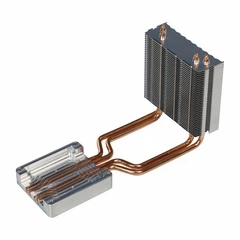
As a supplier of Aluminum Finned Heat Sinks, I've witnessed firsthand the intricate relationship between product quality and performance. One critical factor that often goes unnoticed but significantly impacts the efficiency of an aluminum finned heat sink is the fin thickness uniformity. In this blog, I'll delve into how this seemingly minor aspect can have major implications for the overall performance of these heat sinks.
Understanding Aluminum Finned Heat Sinks
Before we explore the impact of fin thickness uniformity, let's briefly understand what aluminum finned heat sinks are and their function. These heat sinks are essential components in various electronic devices, from computers to industrial machinery. Their primary role is to dissipate heat generated by electronic components, preventing overheating and ensuring the stable operation of the equipment.
Aluminum is a popular choice for heat sinks due to its excellent thermal conductivity, lightweight nature, and cost - effectiveness. The fins on the heat sink increase the surface area available for heat transfer, allowing for more efficient cooling. However, the effectiveness of these fins is not solely determined by their presence but also by their physical characteristics, including thickness uniformity.
The Significance of Fin Thickness Uniformity
Heat Transfer Efficiency
One of the most direct impacts of fin thickness uniformity on the performance of an aluminum finned heat sink is heat transfer efficiency. When the fins have uniform thickness, heat can be distributed more evenly across the surface of the heat sink. This is because the rate of heat conduction through a material is directly related to its cross - sectional area and thermal conductivity.
In a heat sink with non - uniform fin thickness, areas with thinner fins will have a lower cross - sectional area for heat conduction. As a result, heat transfer through these areas will be slower, creating temperature gradients within the heat sink. These gradients can lead to hotspots, where the temperature is significantly higher than in other parts of the heat sink. Hotspots can reduce the overall efficiency of the heat sink and potentially damage the electronic components it is meant to protect.
On the other hand, a heat sink with uniform fin thickness ensures that heat is transferred at a consistent rate across all fins. This leads to a more even temperature distribution, maximizing the heat transfer efficiency and allowing the heat sink to operate at its full potential.
Structural Integrity
Fin thickness uniformity also plays a crucial role in the structural integrity of the heat sink. Aluminum fins are often subject to mechanical stresses, such as vibrations and thermal expansion and contraction. Non - uniform fin thickness can create weak points in the structure, making the fins more prone to bending, cracking, or breaking.
For example, if some fins are significantly thinner than others, they will be less able to withstand mechanical forces. Over time, these thin fins may deform or break, reducing the surface area available for heat transfer and compromising the overall performance of the heat sink. In contrast, a heat sink with uniform fin thickness provides a more balanced and robust structure, ensuring that the fins can withstand the stresses of normal operation without significant damage.
Airflow Resistance
Another factor affected by fin thickness uniformity is airflow resistance. In many applications, air is used to cool the heat sink by flowing over the fins. The shape and thickness of the fins can influence the way air moves through the heat sink.
Non - uniform fin thickness can create irregularities in the airflow path, increasing the resistance to air movement. This means that more energy is required to force air through the heat sink, which can lead to higher power consumption for the cooling system. Additionally, the uneven airflow can result in areas of stagnant air, reducing the effectiveness of the cooling process.
A heat sink with uniform fin thickness provides a more streamlined airflow path, reducing resistance and allowing air to flow more freely over the fins. This improves the convective heat transfer coefficient, enhancing the overall cooling performance of the heat sink.
Real - World Applications and Examples
To illustrate the importance of fin thickness uniformity, let's look at some real - world applications.
High - Power Efficient Stacked Heat Sink
In high - power applications, such as High - Power Efficient Stacked Heat Sink, the demand for efficient heat dissipation is extremely high. These heat sinks are designed to handle large amounts of heat generated by high - power electronic components.
If the fin thickness is not uniform in a high - power stacked heat sink, the heat transfer efficiency will be severely compromised. The hotspots created by non - uniform fins can cause the temperature of the electronic components to rise rapidly, leading to reduced performance and potentially premature failure. Moreover, the structural integrity of the stacked design is crucial, and non - uniform fin thickness can weaken the overall structure, making it more susceptible to damage during operation.
DCC Power Control Stacked Dual - Sided Heatsink
The DCC Power Control Stacked Dual - Sided Heatsink is used in power control applications, where precise temperature management is essential. Non - uniform fin thickness can disrupt the heat transfer process, leading to inaccurate power control and potential malfunctions in the system.
The dual - sided design of this heat sink also means that airflow management is critical. Any irregularities in fin thickness can cause uneven airflow on both sides, reducing the cooling efficiency and increasing the risk of overheating.
Air - Cooled Laser Module Heatsink
In Air - Cooled Laser Module Heatsink, the performance of the laser module is highly dependent on the temperature. Even a slight increase in temperature can affect the output power, beam quality, and lifespan of the laser.
A heat sink with non - uniform fin thickness can create hotspots that can damage the laser module. The uniform distribution of heat is crucial for maintaining the stability and performance of the laser. Additionally, the airflow resistance caused by non - uniform fins can reduce the effectiveness of the air - cooling system, further exacerbating the temperature issues.


Ensuring Fin Thickness Uniformity in Manufacturing
As a supplier of aluminum finned heat sinks, we understand the importance of fin thickness uniformity and take several measures to ensure it during the manufacturing process.
Precision Manufacturing Techniques
We use advanced manufacturing techniques, such as precision machining and extrusion, to produce fins with consistent thickness. These techniques allow us to control the dimensions of the fins with high accuracy, ensuring that each fin has the same thickness within a tight tolerance range.
Quality Control Measures
In addition to precision manufacturing, we also implement strict quality control measures. Our quality control team conducts regular inspections of the heat sinks using advanced measurement tools, such as micrometers and profilometers. These tools can accurately measure the thickness of the fins at multiple points, allowing us to identify any deviations from the specified thickness.
Any heat sinks that do not meet our strict quality standards are rejected, ensuring that only heat sinks with uniform fin thickness are delivered to our customers.
Conclusion
In conclusion, fin thickness uniformity is a critical factor that significantly affects the performance of aluminum finned heat sinks. It impacts heat transfer efficiency, structural integrity, and airflow resistance, all of which are essential for the proper functioning of the heat sink and the electronic components it protects.
As a supplier, we are committed to providing high - quality aluminum finned heat sinks with uniform fin thickness. Our advanced manufacturing techniques and strict quality control measures ensure that our heat sinks meet the highest standards of performance and reliability.
If you are in need of high - performance aluminum finned heat sinks for your applications, we invite you to contact us for procurement and further discussions. We are confident that our products will meet your requirements and provide you with the best cooling solutions.
References
- Incropera, F. P., & DeWitt, D. P. (2002). Fundamentals of Heat and Mass Transfer. Wiley.
- Holman, J. P. (2010). Heat Transfer. McGraw - Hill.
- Kays, W. M., Crawford, M. E., & Weigand, B. (2005). Convective Heat and Mass Transfer. McGraw - Hill.