


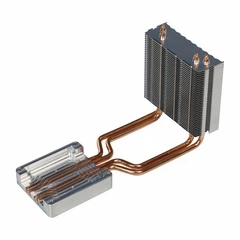
In the field of thermal management, heat pipe aluminum heat sinks play a crucial role in dissipating heat efficiently from various electronic and mechanical devices. As a leading supplier of heat pipe aluminum heat sinks, I've witnessed firsthand the impact of different connection methods between the heat pipe and the aluminum base on the heat transfer efficiency. In this blog, we'll explore how these connection methods can make a significant difference.
Understanding the Basics of Heat Pipe Aluminum Heat Sinks
Before delving into the connection methods, let's briefly understand the components of a heat pipe aluminum heat sink. A heat pipe is a highly efficient heat transfer device that uses a phase - change process. It contains a working fluid that evaporates at the hot end, absorbing heat, and then condenses at the cold end, releasing the heat. The aluminum base serves as the interface between the heat source and the heat pipe, and also provides a platform for the attachment of fins to increase the surface area for heat dissipation.
Different Connection Methods and Their Impact on Heat Transfer Efficiency
1. Soldering
Soldering is one of the most common methods of connecting heat pipes to the aluminum base. In this process, a solder material is used to create a strong bond between the heat pipe and the aluminum surface. When done correctly, soldering can provide excellent thermal conductivity. The solder fills the gaps between the heat pipe and the base, reducing the thermal resistance at the interface.
The advantage of soldering is that it can achieve a relatively low thermal resistance, which means that heat can be transferred more efficiently from the heat source to the heat pipe. However, soldering requires precise control of temperature and soldering materials. If the soldering process is not carried out properly, it may lead to voids or uneven solder distribution, which can increase the thermal resistance and reduce the heat transfer efficiency.
2. Press - fitting
Press - fitting involves physically pressing the heat pipe into a pre - machined groove in the aluminum base. This method is relatively simple and cost - effective. The pressure exerted during the press - fitting process ensures good contact between the heat pipe and the base.
However, the heat transfer efficiency of press - fitting may be limited compared to soldering. The contact between the heat pipe and the base may not be as perfect as in soldering, resulting in a higher thermal resistance at the interface. Additionally, over time, the pressure may relax, leading to a further increase in thermal resistance.
3. Bonding with Thermal Adhesive
Using a thermal adhesive to bond the heat pipe to the aluminum base is another option. Thermal adhesives are designed to have high thermal conductivity and can fill the gaps between the heat pipe and the base. This method is relatively easy to implement and can provide a good seal.
However, the thermal conductivity of thermal adhesives is generally lower than that of solders. Therefore, the heat transfer efficiency may be slightly lower compared to soldering. Moreover, the long - term stability of thermal adhesives can be a concern, as they may degrade over time due to factors such as temperature cycling.
Case Studies and Real - World Applications
Let's take a look at some real - world applications to better understand the impact of connection methods on heat transfer efficiency.
In Communication Modules
In communication modules, heat dissipation is critical to ensure the stable operation of electronic components. Our Aluminum Heat Pipe Communication Module Heatsink uses a soldering connection method. This allows for efficient heat transfer from the high - power chips to the heat sink, maintaining the temperature within a safe range. The low thermal resistance achieved through soldering ensures that the communication module can operate at high performance without overheating.
In Automotive Controllers
Automotive controllers generate a significant amount of heat during operation. Our Automotive Controller Water Cooling Plate and Lightweight Automotive Controller Water Cooling Plate use a combination of press - fitting and thermal adhesive in some cases. While press - fitting provides a basic mechanical connection, the thermal adhesive helps to improve the thermal contact between the heat pipe and the base. This combination is a cost - effective solution for automotive applications, where space and weight are also important considerations.


Factors Affecting the Choice of Connection Method
When choosing the connection method between the heat pipe and the aluminum base, several factors need to be considered.
Thermal Requirements
If high heat transfer efficiency is the primary concern, soldering is often the best choice. For applications where the heat load is relatively low, press - fitting or bonding with thermal adhesive may be sufficient.
Cost
Soldering is generally more expensive than press - fitting or using thermal adhesives. The cost of soldering materials, equipment, and labor needs to be taken into account. For cost - sensitive applications, press - fitting or thermal adhesive bonding may be more suitable.
Manufacturing Complexity
Soldering requires more precise control and specialized equipment, making it more complex to manufacture. Press - fitting is relatively simple and can be easily automated. Thermal adhesive bonding also has a relatively low manufacturing complexity.
Conclusion
The connection method between the heat pipe and the aluminum base has a significant impact on the heat transfer efficiency of a heat pipe aluminum heat sink. Each connection method has its own advantages and disadvantages, and the choice of method depends on various factors such as thermal requirements, cost, and manufacturing complexity.
As a heat pipe aluminum heat sink supplier, we are committed to providing high - quality products with the most suitable connection methods for different applications. If you are in need of heat pipe aluminum heat sinks for your projects, we invite you to contact us for a detailed discussion. We can help you choose the best solution based on your specific requirements.
References
- Incropera, F. P., & DeWitt, D. P. (2002). Fundamentals of Heat and Mass Transfer. John Wiley & Sons.
- Kakaç, S., & Pramuanjaroenkij, A. (2005). Heat Pipes: Theory, Design, and Applications. Butterworth - Heinemann.